Required section · Section 4 of 6
Guided example: auditing one morning of STAT chemistry
A bench technologist audits one week of STAT chemistry orders to check formula integrity and build a TAT summary before the morning huddle. The raw-data sheet holds specimen identifiers SP-1 through SP-7, Test, Order time, Receipt time, Result time, Result value, and Units, copied unedited from the LIS export.
The analysis sheet computes TAT in minutes as (Result time minus Received time) times 1440, formatted as a plain number rather than a raw date serial, so the units on screen match the units in the caption. For SP-2, potassium was received at 07:21 and reported at 08:40, giving a TAT of 79 minutes. For SP-6, no result time exists because the specimen was quantity-not-sufficient (QNS); the formula must return a text flag such as 'QNS - not reported,' not a blank or a zero, or a downstream average would silently understate the true TAT.
The flag formula nests IF statements: if the result is blank, flag QNS; else if the test is potassium and the result exceeds 5.5 mmol/L, flag a critical value; else if the test is troponin and the result exceeds 0.4 ng/mL, flag above the decision limit; otherwise flag within reported range.
These decision points (5.5 mmol/L, 0.4 ng/mL) are example values for this case, not cited clinical reference intervals; CLSI EP28-A3c distinguishes a reference interval, drawn from a healthy reference population, from a clinical decision limit, which may come from outcome-based or consensus evidence, and neither should be silently replaced by a locally derived number. A separate XLOOKUP pulls the matching local-policy note from a reference table by test name, so the note travels with the flag without being retyped.
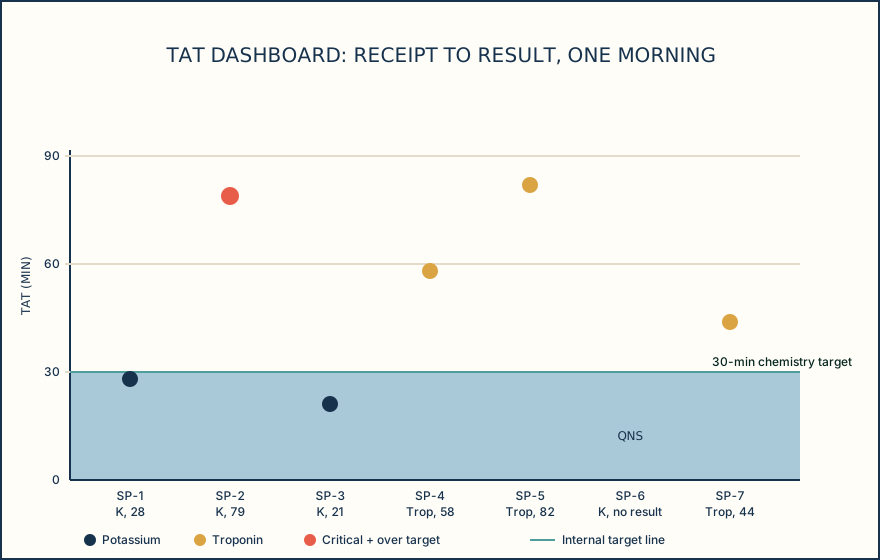
SP-2 shows why the TAT formula and the flag formula must stay separate. Its result (6.2 mmol/L) triggers the critical-value flag under 42 CFR 493.1291, which requires immediate notification of the ordering party for a result indicating an imminent life-threatening condition or a panic/alert value. Its TAT (79 minutes) separately misses a 30-minute internal chemistry target used for this case. A single combined formula risks a delay silently suppressing the critical flag, or the critical flag silently hiding the delay; auditing them with two formulas and two columns keeps both visible.
The missed-TAT count for chemistry, COUNTIFS on Test equals 'Potassium' and TAT greater than 30, returns 1 for this dataset (SP-2 only; SP-1 at 28 minutes and SP-3 at 21 minutes are both under target, and SP-6 is excluded because it has no numeric TAT). With only seven rows spanning one morning, a run chart of daily median TAT is the wrong choice because there are too few time points to show a trend, and a Pareto chart of rejection reasons does not fit because no specimen in this set was rejected. A dot plot of TAT by test next to a table of flags is the honest choice for a dataset this small.
When a result is both clinically flagged and operationally late, audit and report both, because a reader who sees only one may act on an incomplete picture.
Illustrative drawing — this picture was drawn rather than captured.
| Specimen | Test | Received | Reported | TAT (min) | Result | Flag |
|---|---|---|---|---|---|---|
| SP-1 | Potassium | 07:10 | 07:38 | 28 | 4.1 mmol/L | Within reported range |
| SP-2 | Potassium | 07:21 | 08:40 | 79 | 6.2 mmol/L | Critical - notify per policy; TAT over target |
| SP-3 | Potassium | 07:44 | 08:05 | 21 | 3.9 mmol/L | Within reported range |
| SP-4 | Troponin | 08:12 | 09:10 | 58 | 0.02 ng/mL | Within reported range |
| SP-5 | Troponin | 08:30 | 09:52 | 82 | 1.85 ng/mL | Above decision limit - correlate clinically |
| SP-6 | Potassium | 09:05 | not reported | n/a | QNS | QNS - not reported |
| SP-7 | Troponin | 09:36 | 10:20 | 44 | 0.04 ng/mL | Within reported range |
Knowledge checks
Reading and checks are open. Sign in only to save.
Knowledge check 1
Knowledge check 2
Section status
Finish this section
Reading and checks are open. Sign in only to save.
The module finishes after every required section is marked done and every check in those sections is correct.