Required section · Section 2 of 6
Basic mental model: measured fractions, biologic context
HbS results from an HBB p.Glu6Val variant. When deoxygenated, HbS can polymerize into rigid fibers that reduce red-cell deformability. That mechanism supplies context for sickled forms and for clinical complications, but the analyzer does not measure polymer fibers when it reports a fraction. Keep the molecular mechanism separate from the separation result.
Fraction accounting asks what is present, what may be altered, and what is missing. Read HbA, HbA2, HbF, and the provisional HbS-family fraction together with age, CBC, reticulocytes, medication history, and transfusion history. No single percentage is universal across patients or methods. Hydroxyurea can increase HbF and mean corpuscular volume, while transfused donor blood can introduce HbA.
A useful pattern family is more defensible than disease-name guessing. HbSS, HbSC, HbS/beta-zero thalassemia, and HbS/beta-plus thalassemia have heterogeneous findings, and microcytosis can raise HbS/beta-thalassemia in the differential without excluding iron deficiency. Record the evidence and the uncertainty before choosing confirmation. Account for every reported fraction before using the pattern to narrow a differential.
Illustrative drawing — this picture was drawn rather than captured.
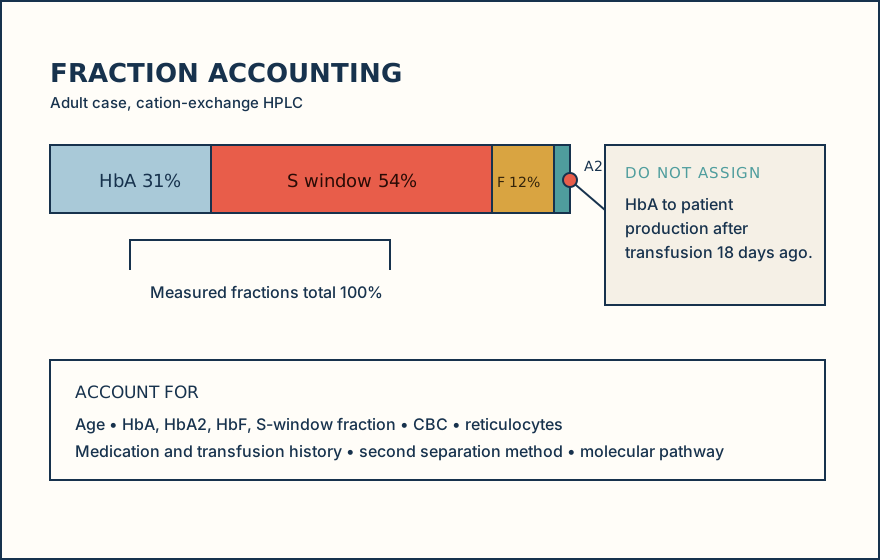
| Fraction | Value | Interpretive boundary |
|---|---|---|
| HbA | 31.0% | May include donor red-cell HbA after transfusion |
| S-window fraction | 54.0% | Provisional HbS-family fraction |
| HbF | 12.0% | Requires age and medication context |
| HbA2 | 3.0% | Within this laboratory's verified interval |
Reusable sequence for an HbS-containing pattern.
Verify context
Confirm specimen type, age, current medication, and transfusion history before interpreting fractions.
Account for fractions
Read HbA, HbA2, HbF, and the provisional variant fraction with CBC and reticulocytes.
Pair a method
Use a complementary separation principle or molecular pathway when the first method is not specific.
Release bounded result
Report what is supported and follow the local confirmation and authorization pathway.
Knowledge checks
Reading and checks are open. Sign in only to save.
Knowledge check 1
Knowledge check 2
Section status
Finish this section
Reading and checks are open. Sign in only to save.
The module finishes after every required section is marked done and every check in those sections is correct.