Required section · Section 3 of 6
Focused instruction: variability and look-alikes
Calculate transferrin saturation as serum iron divided by TIBC multiplied by 100. Serum iron and saturation have substantial biologic variability, so collection timing, food, and recent oral iron exposure matter when comparing results. The Mayo Clinic Laboratories SFEC catalog entry prefers collection before noon, eight-hour fasting when feasible, and no iron-containing supplement for 24 hours; local assay instructions remain controlling.
Group ferritin elevation by the iron-pattern mechanism and link each pattern to transport measurements and comparison conditions. Acute-phase signaling or cell injury can raise ferritin while TSAT is normal or low and transferrin/TIBC may fall; record C-reactive protein, liver indices, collection time, fasting status, and recent oral iron. Reduced transferrin production can raise calculated TSAT when TIBC is low; review liver context and the measured TIBC. Repeated transfusion or ineffective erythropoiesis can increase both ferritin and TSAT; compare serial values only when treatment history and collection context are available. A compatible hereditary pattern has persistently increased TSAT with ferritin elevation and requires the EASL confirmation pathway.
The Mayo Clinic Laboratories SFEC catalog entry gives collection guidance; EASL Clinical Practice Guidelines on haemochromatosis state that fasting does not improve diagnostic utility but recommend morning sampling. Compare serial TSAT, transferrin/TIBC, and ferritin only with collection context documented. EASL biochemical-suspicion thresholds and its MRI/biopsy confirmation rule are guidance thresholds, not laboratory reference intervals.
Illustrative drawing — this picture was drawn rather than captured.
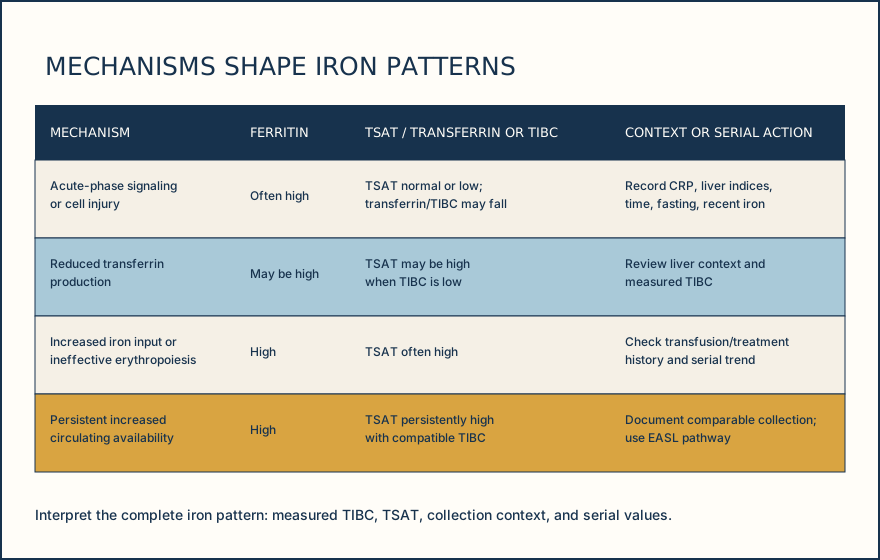
| Mechanism / iron-pattern effect | Ferritin | TSAT and transferrin/TIBC | Collection or serial action |
|---|---|---|---|
| Acute-phase response or cell injury | Often high | TSAT normal or low; transferrin/TIBC may decrease | Record CRP, liver indices, timing; compare serial values |
| Reduced transferrin production | May be high | TSAT may be high because TIBC is low | Review liver context and measured TIBC before inferring loading |
| Repeated transfusion or ineffective erythropoiesis | High | TSAT often high | Check transfusion/treatment history and serial trend |
| Persistent increased circulating iron availability | High | TSAT persistently high with compatible transferrin/TIBC | Use EASL threshold and confirmation pathway; do not diagnose from one panel |
Knowledge checks
Reading and checks are open. Sign in only to save.
Knowledge check 1
Knowledge check 2
Section status
Finish this section
Reading and checks are open. Sign in only to save.
The module finishes after every required section is marked done and every check in those sections is correct.