Required section · Section 4 of 6
Guided example: calculate, then rank evidence
For this case, 186 divided by 285 multiplied by 100 equals 65.3%. Under the laboratory rounding policy, transferrin saturation is reported as 65%. This is above the 14-50% teaching reference interval and above the EASL biochemical-suspicion context for an adult male when ferritin is also above 300 micrograms/L.
The normal C-reactive protein makes an acute inflammatory explanation less supported, but it does not exclude every nonspecific cause of high ferritin. Mildly increased alanine aminotransferase keeps liver injury relevant because it can alter ferritin and saturation. The next interpretation must preserve both observations rather than selecting a diagnosis from one marker.
HFE targeted testing in this case reports C282Y homozygous and H63D not detected. That result adds susceptibility evidence to the compatible biochemical pattern, but it does not measure hepatic iron or prove organ injury. Show the calculation, collection facts, and contradictory or remaining evidence together in the result review.
Illustrative drawing — this picture was drawn rather than captured.
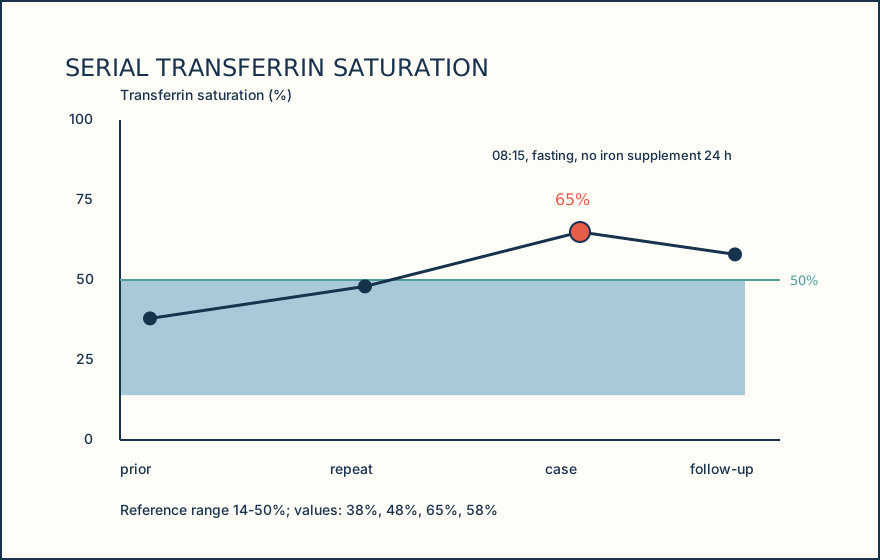
| Collection | Context | Transferrin saturation |
|---|---|---|
| Prior | 08:05, fasting, no supplement 24 hours | 38% |
| Repeat | 09:10, fasting, no supplement 24 hours | 48% |
| Guided case | 08:15, fasting, no supplement 24 hours | 65% |
| Follow-up | 08:25, fasting, no supplement 24 hours | 58% |
Ordering exercise
Put the guided-case review steps in the order that keeps measurement, pattern, and report scope separate.
1. Review targeted HFE result
Read C282Y and H63D as susceptibility evidence with stated assay scope.
2. Rank the differential
Compare inflammation, liver injury, secondary loading, and hereditary pattern.
3. Calculate saturation
Divide serum iron by TIBC and multiply by 100.
4. Confirm collection context
Review time, fasting status, recent iron, and specimen indices.
Knowledge checks
Reading and checks are open. Sign in only to save.
Knowledge check 1
Section status
Finish this section
Reading and checks are open. Sign in only to save.
The module finishes after every required section is marked done and every check in those sections is correct.