Required section · Section 4 of 6
Work the result set in time order
At 09:05, the technologist verifies identifiers, K2EDTA collection time, specimen acceptability, analyzer quality-control status, and smear/stain quality. A systematic scan confirms the CBC pattern, blast-like cells, Auer rods, and an abnormal promyelocyte-rich field. The technologist documents the observable evidence and obtains the local qualified second review or escalation as required; neither action turns the finding into a final diagnosis.
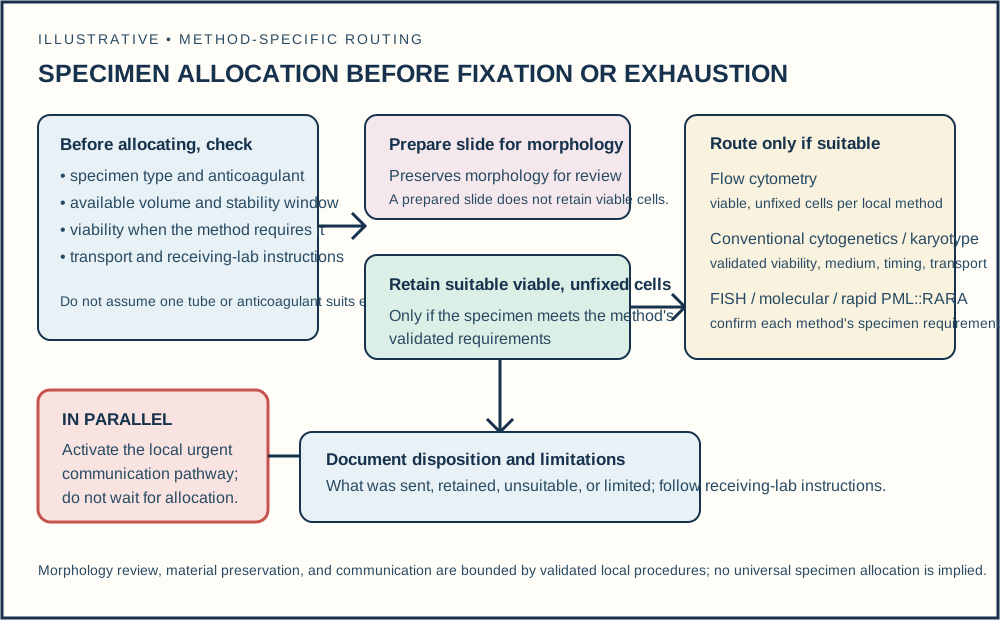
Urgent communication and allocation occur in parallel. While the locally defined urgent pathway is called, a suitable unfixed, viable aliquot is routed under the local acute-leukemia procedure to flow cytometry and conventional cytogenetics, with material retained or routed for FISH, molecular testing, and rapid testing for PML::RARA, the defining fusion of APL, as locally validated. The technologist records specimen type, anticoagulant, volume, stability, viability when required, transport conditions, time, destination, and any limitation rather than assuming every assay can use the remaining material.
Fibrinogen 92 mg/dL, prothrombin time 18.8 seconds, and international normalized ratio 1.6 are APL-associated coagulopathy correlation data in this morphology context. Potassium 4.8 mmol/L, creatinine 1.0 mg/dL, uric acid 7.9 mg/dL, phosphorus 4.4 mg/dL, and lactate dehydrogenase 1320 U/L are tumor-lysis chemistry context. These are separate urgent processes: coagulation testing and rapid PML::RARA testing address suspected APL, whereas serial metabolic evaluation is used for tumor-lysis assessment under local and clinical pathways. Neither set establishes leukemia subtype or treatment thresholds.
The laboratory releases only components that meet validated release criteria; it holds or suppresses components that require review under its procedure, and performs or reports a manual differential only when indicated and validated. A BLAST? flag does not by itself dictate that every CBC component be held, and a manual differential does not confirm subtype. Notification documentation includes the recipient, time, result or concern communicated, and read-back when required. Protect viable material and make the urgent call without delaying either for final classification.
Illustrative drawing — this picture was drawn rather than captured.
| Analyte | Value | Status / interpretive boundary |
|---|---|---|
| Fibrinogen | 92 mg/dL | Below the local reference interval in this scenario; APL-associated coagulopathy correlation, not PML::RARA confirmation |
| PT | 18.8 s | Above the local reference interval in this scenario; APL-associated coagulopathy correlation, not PML::RARA confirmation |
| INR | 1.6 | Above the local reference interval in this scenario; APL-associated coagulopathy correlation, not PML::RARA confirmation |
| Potassium | 4.8 mmol/L | Tumor-lysis chemistry context; compare with the local interval and assess serially under local and clinical pathways |
| Creatinine | 1.0 mg/dL | Tumor-lysis chemistry context; compare with the local interval; one value does not exclude risk |
| Uric acid | 7.9 mg/dL | Tumor-lysis chemistry context; compare with the local interval; not APL confirmation |
| Phosphorus | 4.4 mg/dL | Tumor-lysis chemistry context; compare with the local interval; not APL confirmation |
| LDH | 1320 U/L | Tumor-lysis chemistry context; compare with the local interval; not APL confirmation |
Knowledge checks
Reading and checks are open. Sign in only to save.
Knowledge check 1
Knowledge check 2
Section status
Finish this section
Reading and checks are open. Sign in only to save.
The module finishes after every required section is marked done and every check in those sections is correct.