Required section · Section 2 of 6
Basic mental model
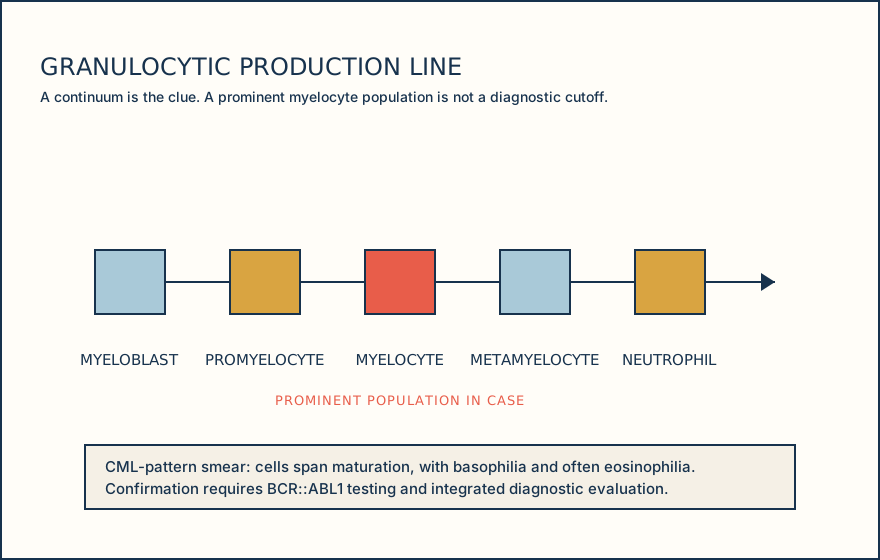
Granulopoiesis normally proceeds from blast through promyelocyte, myelocyte, metamyelocyte, band, and segmented neutrophil. A peripheral smear can show some immature forms in reactive states, but distribution matters more than any single cell type. In this case, the broad continuum and prominent myelocytes are a pattern clue. They are not a validated diagnostic cutoff.
Basophilia is particularly important because an absolute count, not only the differential percentage, makes its scale visible. Eosinophilia may accompany the pattern. Platelet elevation adds supporting evidence but neither confirms the process nor determines disease phase. Correlate the smear with the analyzer flags, CBC, and clinical information available to the laboratory.
The production-line model is reusable at the bench because it prevents overcalling an isolated left shift. It also makes clear why morphology is a triage signal for confirmatory testing, not a substitute for it. When several maturation stages and absolute basophilia travel together, preserve the finding in the review comment and follow the local reflex or referral pathway.
Illustrative drawing — this picture was drawn rather than captured.
Bounded laboratory path from pattern recognition to interpretable molecular monitoring.
Recognize the pattern
Review CBC flags and smear for neutrophilic leukocytosis across maturation with absolute basophilia and possible eosinophilia.
Confirm the fusion
Use the local BCR::ABL1 diagnostic pathway with morphology and chromosome analysis integrated as appropriate.
Identify transcript
Record the detected transcript so an appropriate follow-up assay can be selected.
Protect the trend
Review transcript, method, documented International Scale (IS) calibration or conversion, sensitivity, and comparability. The International Scale is the standardized reporting scale for compatible standard BCR::ABL1 transcripts; documented calibration or conversion is required before linking cross-laboratory values. Release comparable trends; otherwise preserve the result, document the limit, and route it for molecular review or unresolved-trend suppression.
Knowledge checks
Reading and checks are open. Sign in only to save.
Knowledge check 1
Section status
Finish this section
Reading and checks are open. Sign in only to save.
The module finishes after every required section is marked done and every check in those sections is correct.