Required section · Section 2 of 6
Basic mental model
Children are not small adults on the CBC. Published pediatric intervals partition hemoglobin, MCV, reticulocytes, red-cell count, RDW, platelets, and differential counts by age. The laboratory releases results against its own validated interval for the analyzer, specimen type, units, and age partition.
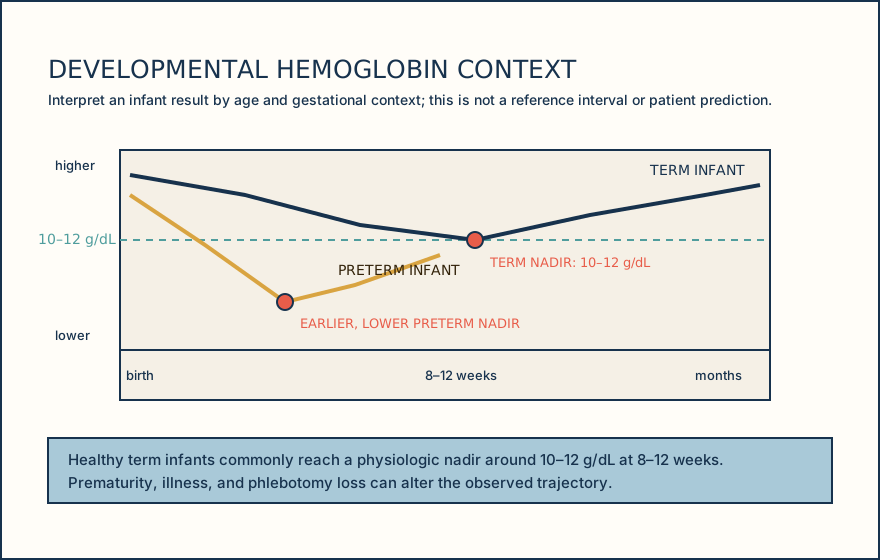
A healthy term infant commonly reaches a physiologic hemoglobin nadir near 8 to 12 weeks, often 10 to 12 g/dL. In preterm infants the nadir is earlier and lower. This is a nonquantitative developmental model, not a reference interval or a patient-specific prediction.
World Health Organization hemoglobin cutoffs are population and clinical criteria, not substitutes for a laboratory reference interval. In 2024, the stated anemia cutoff is below 105 g/L at 6 to 23 months and below 110 g/L at 24 to 59 months. Keep the distinction visible when communicating an abnormal CBC.
Use the local pediatric interval for release, and state separately when a population cutoff is being discussed.
Illustrative drawing — this picture was drawn rather than captured.
Pediatric CBC interpretation and follow-up sequence
Compare by age
Confirm exact age, gestational context when relevant, specimen type, analyzer, and local pediatric interval.
Identify anemia or microcytosis
Decide whether hemoglobin or MCV is outside the applicable interval; do not substitute an adult interval.
Assess response
Interpret ARC against its age-specific interval to identify an increased, absent, or indeterminate regenerative response.
Interpret the pattern
Use red-cell count, RDW, platelets, ferritin, inflammatory context, and locally validated Ret-He together.
Decide on smear review
Review morphology when the CBC pattern or local rules indicate it; do not use absent stippling as lead exclusion.
Report and route follow-up
Preserve specimen type, use bounded report wording, and route recollection, venous confirmation, notification, and local-policy follow-up.
Knowledge checks
This section has no knowledge checks.
Section status
Finish this section
Reading and checks are open. Sign in only to save.
The module finishes after every required section is marked done and every check in those sections is correct.