Required section · Section 5 of 6
Learner decision: triage three cases
Case A is the 3-year-old with hemoglobin 7.8 g/dL, platelets 42 × 10^9/L, ANC 0.8 × 10^9/L, an immature-cell flag, a smear-confirmed 2% blast population, and a small remaining EDTA aliquot. Preserve the aliquot immediately, in parallel with the CBC and smear, contact the receiving flow laboratory before assuming the EDTA tube is usable there, follow the local urgent communication pathway, and document that communication. A white count within the cited study interval does not make low counts, a low ANC, and blasts routine.
Case B is the 8-year-old with WBC 186 × 10^9/L, newly diagnosed B-lymphoblastic leukemia, and serial tumor-lysis chemistry drawn from the start of induction chemotherapy through 12 hours. Notify the responsible clinical team immediately when the approved alert criterion is met, then document the communication and protect the specimen workflow. Keep laboratory TLS (two or more qualifying metabolic abnormalities in the defined window), clinical TLS (laboratory TLS plus a clinical consequence), leukostasis (a separate hyperviscosity syndrome from the blast count), and risk markers (pretreatment WBC, LDH, and uric acid) as four distinct ideas; do not turn the chemistry into a treatment recommendation or diagnose tumor lysis from one number.
Case 4 is the newborn screened on day 3 of life who received a simple (non-exchange) transfusion of 15 mL/kg leukoreduced packed red cells on day 1, two days before the dried-blood-spot collection, and whose screen shows an FA pattern with a lower HbF fraction than expected for a 3-day-old infant. Treat the screen as transfusion-affected rather than the infant's true baseline, and route the jurisdictional repeat dried-blood-spot workflow rather than accepting the transfusion-influenced pattern as final. Confirm transfusion history, because the affected specimen was collected within the transfusion-affected interval and the state algorithm controls repeat timing.
The allocation board is a decision aid, not a universal volume rule. Use locally validated minimum volumes, sharing rules, and priority order, while avoiding duplicate draws. When specimen is limited, preserve it immediately alongside the tests already running, and protect the information that changes the next diagnostic decision.
Illustrative drawing — this picture was drawn rather than captured.
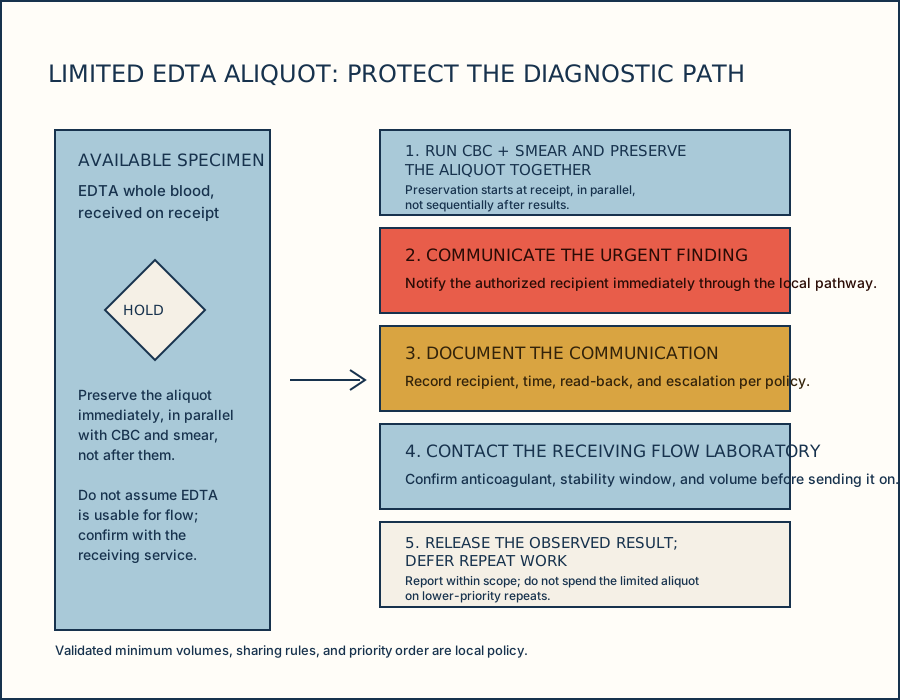
Ordering exercise
Place the actions for case A in the order that protects the urgent diagnostic pathway.
1. Defer lower-priority repeat work
Avoid consuming limited material before the time-sensitive pathway is clear.
2. Communicate the urgent finding
Notify the authorized recipient through the local urgent pathway.
3. Contact the receiving flow laboratory
Confirm the EDTA aliquot's anticoagulant, stability window, and volume are acceptable there before it is sent.
4. Preserve the aliquot in parallel with CBC and smear
Reserve the remaining EDTA material immediately at receipt, not after the CBC and smear result.
5. Document the communication
Record the recipient, time, read-back, and any escalation, separate from the communication itself.
6. Verify CBC and smear evidence
Confirm cytopenias, the ANC, the flag, and the blast morphology as results return.
Knowledge checks
Reading and checks are open. Sign in only to save.
Knowledge check 1
Knowledge check 2
Section status
Finish this section
Reading and checks are open. Sign in only to save.
The module finishes after every required section is marked done and every check in those sections is correct.