Required section · Section 3 of 6
Testing domains, product release, and where results stop being interchangeable
Before conditioning, each testing domain answers a different question. DNA-based high-resolution HLA typing establishes donor-recipient matching, while recipient anti-HLA antibody testing identifies donor-specific reactivity for the donor-selection discussion; neither result authorizes the transplant by itself. Donor infectious-disease screening supports the complete donor eligibility determination the FDA HCT/P donor-testing requirements define. A partial disease-by-disease test list invites a technologist to treat it as the whole requirement; eligibility is a single determination that depends on the complete testing and screening record, not any one test result in isolation. ABO/Rh typing, antibody screening, and transfusion history establish the starting point for compatible transfusion planning. Baseline CBC, chemistry, and organ-function results provide comparison points for the expected post-conditioning nadir and later complication workups. At the bench, report the domain and what its result supports rather than collapsing all of these findings into one "pretransplant cleared" result.
CD34-positive cell enumeration by flow cytometry measures an immunologically defined cell population using a validated specimen, staining, acquisition, analysis, and reporting process, consistent with the principles in CLSI H42. The product dose is reported on a viable-CD34-positive-cells-per-kilogram-of-recipient-weight basis using the program's validated calculation, and no population reference interval applies because this is a dose calculation, not a patient reference test. In this case, the flow assay acquires the product aliquot on a viable-cell gate set by a dye-exclusion viability stain, so nonviable events are excluded before the CD34-positive percentage is calculated, not after; the assay reports 94% viability, 0.62% of viable gated events as CD34-positive, and an aliquot total nucleated cell (TNC) count of 6.552 × 10^10 cells (equivalent to 8.4 × 10^8/kg once divided by the recipient's actual body weight, below). Instrument and reagent quality control for that run includes a count-verified calibration bead standard and a fluorescence-minus-one or isotype control to set the CD34-positive gate; a run with QC outside its validated range is not used to calculate a reportable dose. The recipient-weight term in the calculation uses the program-declared weight source, which in this case is the recipient's actual body weight of 78 kg recorded at the pretransplant workup; some programs instead specify an adjusted or ideal body weight above a defined body-mass threshold, and the weight source used has to be documented alongside the result because it changes the calculated dose. Multiplying the aliquot TNC by viability and the CD34-positive fraction gives 6.552 × 10^10 × 0.94 × 0.0062 ≈ 3.82 × 10^8 viable CD34-positive cells; dividing that count by the recipient's actual body weight of 78 kg gives a viable CD34-positive dose of 4.9 × 10^6/kg. If the same calculation instead produced a dose below the program's declared acceptance threshold, that is a release-exception path, not a silent release: the finding is documented, the transplant program is notified before the product is released, and the program decides among its own predefined options (an additional collection, use of a below-threshold dose only with documented physician acceptance of the risk, or a cryopreserved backup product) rather than the laboratory resolving it alone. Viability, total nucleated cell count, CD34-positive dose, sterility, cryopreservation status, and labeling and traceability are separate product-release domains. A high viability result does not substitute for an adequate CD34 dose, and neither substitutes for a passed sterility result; each domain is read on its own terms and the program's release criteria for each are locally validated fields, not universal numbers. For this case, the acceptance status for each release-review domain is stated next to its result in the accompanying table rather than implied, and a domain with no stated acceptance status carries no acceptance claim.
A sterility culture can take days to result, so a product is sometimes infused under a documented release-authorization-with-culture-pending pathway rather than held until the culture finalizes. That authorization is signed by the role the program designates, states that the interim culture read is "no growth to date," and names who must be notified if the picture changes. The culture is followed to its final read: a final read of "no growth detected" closes the sterility domain with no further action beyond the standard record, while a later-growth result, a culture that later flags positive after the product has already been infused under the pending-result authorization, follows a different path entirely: immediate notification of the transplant team and infection-control or medical-director designee, isolate retention and organism identification, and a documented contamination investigation. A result obtained after administration cannot retroactively establish that the product was sterile at infusion, which is exactly why the release and communication procedure has to address the pending-result case and the later-growth case in advance rather than after the fact. Product labels and their accompanying records must maintain identity and traceability through the whole path from collection to administration. A label-to-record mismatch, at any point, is a stop-and-escalate chain-of-identity risk, not a discrepancy to reconcile quietly after the product is already infused.
Conditioning treatment is expected to drive blood counts down before it produces the marrow space donor cells will occupy, and how deep and how long that drop goes depends on regimen intensity (myeloablative versus reduced-intensity or non-myeloablative), not on a single fixed pattern. A falling absolute neutrophil count (ANC) or platelet count in the days right after conditioning is the expected cytopenic nadir, not evidence of graft failure on its own. Engraftment is commonly recorded using a consecutive-day rule: the ANC-recovery date is recorded as the first of three consecutive days with ANC at or above 0.5 × 10^9/L, and the platelet-recovery date is recorded, separately, as the first of three consecutive days with platelets at or above 20 × 10^9/L without a platelet transfusion in the preceding seven days. In both criteria the milestone date recorded is the first qualifying day, confirmed once the following two days also qualify; the date is not the day the third value arrives. These are illustrative reporting definitions consistent with the American Society for Transplantation and Cellular Therapy's standardized recovery definitions, and every transplant program declares its own operational criterion. A single count meeting the threshold on one day is not the same statement as a program-declared engraftment milestone until the following two days confirm it.
Illustrative drawing — this picture was drawn rather than captured.
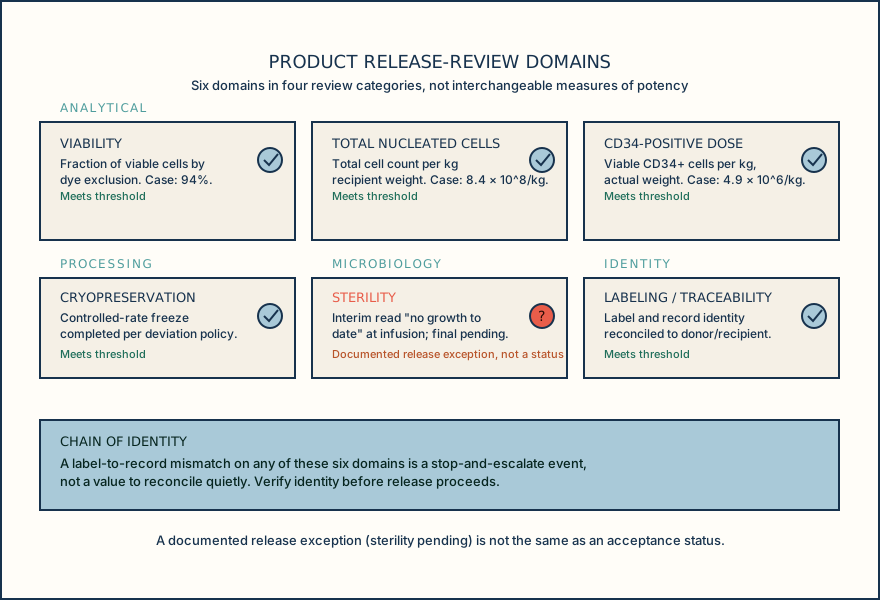
| Domain | Review category | Result | Acceptance status | Context |
|---|---|---|---|---|
| Viable CD34-positive dose | Analytical | 4.9 × 10^6/kg recipient weight (actual body weight 78 kg) | Meets program's acceptance threshold | Program release criteria and validated calculation worksheet apply |
| Viability | Analytical | 94% | Meets program's acceptance threshold | Dye-exclusion result from the same flow assay, viable-gate basis for the CD34 calculation |
| Total nucleated cell count | Analytical | 8.4 × 10^8/kg recipient weight | Meets program's acceptance threshold | Separate measurement from CD34 dose |
| Cryopreservation status | Processing | Controlled-rate freeze completed, thaw-recovery not yet assessed | Meets program's acceptance threshold | Documented against the program's deviation policy |
| Sterility culture | Microbiology | Pending at infusion; interim read "no growth to date" | Documented release exception: authorized with culture pending, not yet a pass/fail status | Final read follows the no-growth-detected or later-growth path defined by the program's sterility release policy |
| Labeling and traceability | Identity | Label elements reconciled to donor and recipient record | Meets program's acceptance threshold | Any label-to-record mismatch is a stop-and-escalate chain-of-identity event, not an acceptance status |
Knowledge checks
Reading and checks are open. Sign in only to save.
Knowledge check 1
Knowledge check 2
Section status
Finish this section
Reading and checks are open. Sign in only to save.
The module finishes after every required section is marked done and every check in those sections is correct.