Required section · Section 1 of 6
The question at each transplant milestone
A hematopoietic stem-cell transplant (HSCT) program calls the laboratory before collection, during conditioning and infusion, through engraftment, and across months of post-transplant monitoring. Each call asks a different question. Before collection the question is whether the donor and recipient are correctly identified, tested, and matched. At infusion the question is whether the product meets its release criteria and whether its identity is reconciled to the correct patient. In the weeks after infusion the question shifts to whether blood counts are recovering, whether donor cells are engrafting, and whether disease markers are trending in a direction that supports the transplant.
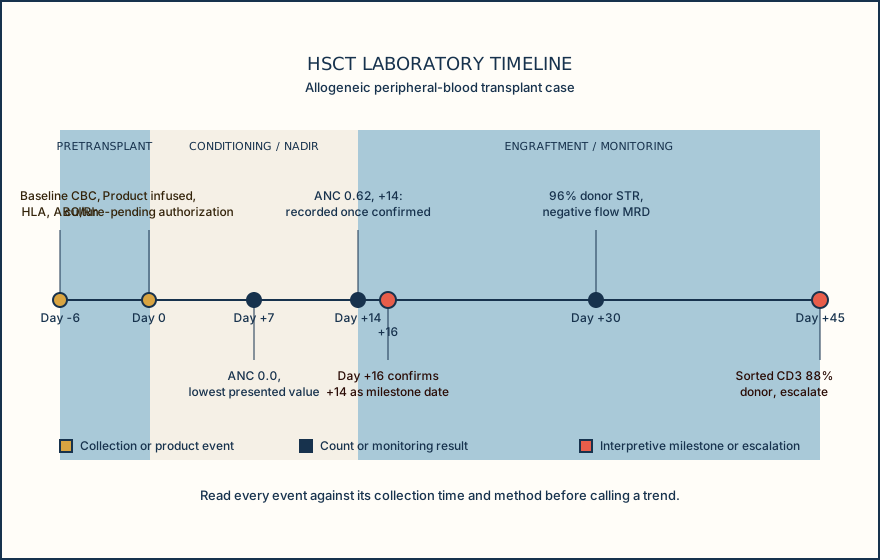
The laboratory timeline shown here follows one case: an adult receiving allogeneic peripheral-blood HSCT for acute myeloid leukemia (AML), donor group A RhD-positive into a recipient who is group O RhD-positive. The case carries a baseline complete blood count (CBC) on day -6, a product aliquot result on day 0, the lowest CBC values in the presented series on day +7, an ambiguous single count on day +14 that becomes the recorded neutrophil-recovery milestone date once day +16 confirms the three-day sequence, and two chimerism results at day +30 and day +45 that are not directly comparable to each other.
A reader who has not worked a transplant bench before might expect one clean number, engrafted or not engrafted, that settles the question. That is not how the evidence behaves. Every count, every product measurement, and every chimerism or measurable residual disease (MRD) result answers a narrow question tied to a specimen, a method, and a collection time. The laboratory's job across this timeline is to keep those questions separate, read each result against its own context, and know which single change in the evidence is the one that needs to leave the laboratory and reach the transplant team.
The question stays the same across this timeline: which laboratory questions arise before collection, during conditioning and infusion, through engraftment, and during post-transplant monitoring, and what does each stage of evidence actually support.
Illustrative drawing — this picture was drawn rather than captured.
Knowledge checks
This section has no knowledge checks.
Section status
Finish this section
Reading and checks are open. Sign in only to save.
The module finishes after every required section is marked done and every check in those sections is correct.