Required section · Section 5 of 6
Learner decision: which trend needs multidisciplinary escalation
By day +45, a new specimen changes the picture. A sorted CD3-positive lineage STR-PCR result reports 88% donor and 12% recipient. "Sorted CD3-positive lineage" means the T-lymphocyte compartment, isolated from whole blood by immunomagnetic or fluorescence-activated sorting on the CD3 T-cell surface marker before STR-PCR is run on that isolated population alone. The report states sort purity, the percentage of the isolated population confirmed to actually be the target CD3-positive lineage on post-sort verification, because a lower purity means more non-target-cell signal diluting the lineage-specific result, and the report also states the assay's analytical sensitivity. The day +45 result is not directly comparable to the day +30 unsorted whole-blood result of 96% donor: before drawing any conclusion from the two numbers side by side, notice what changed between the two draws, specimen type went from unsorted whole blood to a sorted CD3-positive T-cell lineage, which makes them two different measurements rather than two points on one trend line. Lineage-specific chimerism can reveal a cell-compartment pattern that unsorted whole blood does not show, because different cell lineages can carry different donor fractions after transplant, but cell sorting adds its own purity, turnaround-time, and interpretation limits.
This is the milestone evidence the learner decision turns on. The correct action is not to call the day +45 result reassuring because 88% still looks high, and it is not to call it a relapse or rejection signal on its own, because a chimerism result of any kind does not diagnose relapse, rejection, or graft failure by itself. The defensible action is to flag the day +45 lineage-specific result for escalation and multidisciplinary review, because it needs comparison with prior comparable lineage-specific chimerism results (which this case does not yet have), correlation with the day +30 flow-MRD result and any newer MRD testing, and clinical context that only the transplant team holds. A result that cannot yet be explained by method continuity is exactly the kind of trend that belongs in front of more than one discipline.
The chain-of-identity checkpoint earlier in the timeline, the reconciliation of product label to donor and recipient record before infusion, is a different kind of event: a hard stop tied to a single specimen or product, resolved before release proceeds. The day +45 chimerism change is a trend-interpretation event: nothing here is wrong with a single specimen, but the direction and comparability of the evidence needs more eyes before anyone acts on it. Recognizing the difference between a stop-and-fix identity problem and a compare-and-escalate trend problem is itself a bench skill.
A defensible notification about the day +45 chimerism result depends on confirming, in order, five things: the specimen and patient identity, the lineage and sort purity, the assay's validity (informative marker set and validated analytical sensitivity), the existence of a comparable prior result of the same specimen type and lineage, and whether the finding meets the transplant program's declared alert criteria for notification. Only once those five are confirmed does the notification itself go out, stating what changed (donor fraction, lower in the day +45 lineage-specific result compared with day +30 whole blood), what stayed constant or is unknown (no informative prior lineage-specific comparator), and what is not yet established (relapse, rejection, or graft failure are not concluded from this result alone). It also states the specimen type and lineage for both results being compared, because comparing across specimen types without saying so invites exactly the kind of overreading a defensible notification is built to avoid.
Illustrative drawing — this picture was drawn rather than captured.
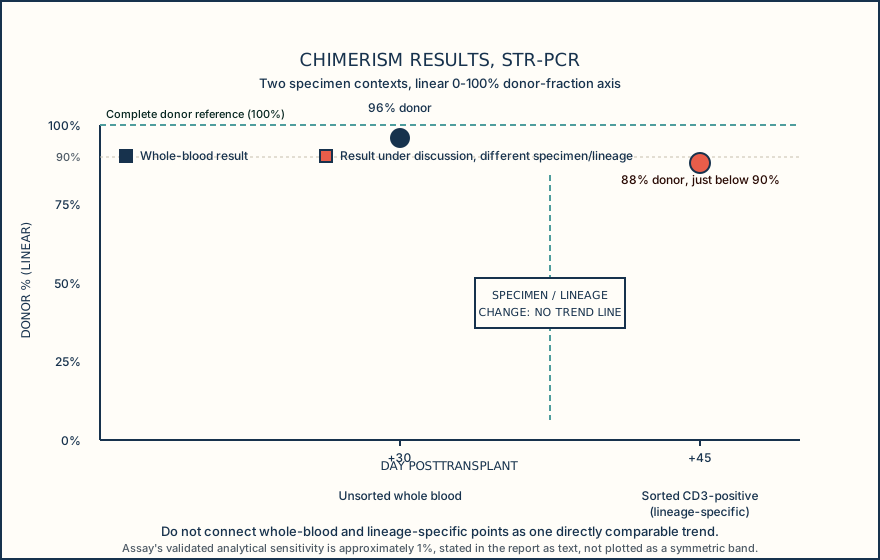
| Day | Specimen | Method | Result | Note |
|---|---|---|---|---|
| +30 | Whole blood, unsorted | STR-PCR, informative markers, ~1% analytical sensitivity | 96% donor, 4% recipient | Detectable mixed chimerism; not a relapse call on its own |
| +30 | Marrow, flow cytometry | Multiparameter flow MRD, 500,000 viable CD45+ events, hemodilution checked | No abnormal myeloid population detected; local detection threshold 0.1% | Different specimen and method from the STR-PCR result; limited to the diagnosis-associated phenotype |
| +45 | Blood, sorted CD3-positive (sort purity stated in report) | STR-PCR, informative markers, sort purity and sensitivity in report | 88% donor, 12% recipient | Lineage-specific; different specimen and lineage from day +30 whole blood, not a decline by itself |
Ordering exercise
Before notifying the transplant team about the day +45 lineage-specific chimerism result, place these review steps in the order a bench technologist should complete them.
1. Notify per the local escalation policy
Communicate the finding and its limitations to the transplant team through the program's declared escalation route.
2. Correlate with MRD and clinical context
Weigh the trend alongside the day +30 flow-MRD result and any clinical information the transplant team holds.
3. Confirm patient identity, specimen, lineage, and sort purity
Verify the specimen belongs to the correct patient, whether the day +45 result is whole blood or a sorted lineage, and record sort purity if sorted.
4. Apply the program's alert criteria
Confirm the finding actually meets the transplant program's declared notification threshold before routing it anywhere.
5. Compare against a comparable prior result
Compare day +45 only against a prior result of the same specimen type and lineage; whole-blood day +30 is not that comparator.
6. Check the assay's validity
Confirm the STR-PCR informative-marker set is informative for this donor-recipient pair and confirm its validated analytical sensitivity.
Knowledge checks
Reading and checks are open. Sign in only to save.
Knowledge check 1
Knowledge check 2
Section status
Finish this section
Reading and checks are open. Sign in only to save.
The module finishes after every required section is marked done and every check in those sections is correct.