Required section · Section 4 of 6
Guided example: reading the count-recovery series
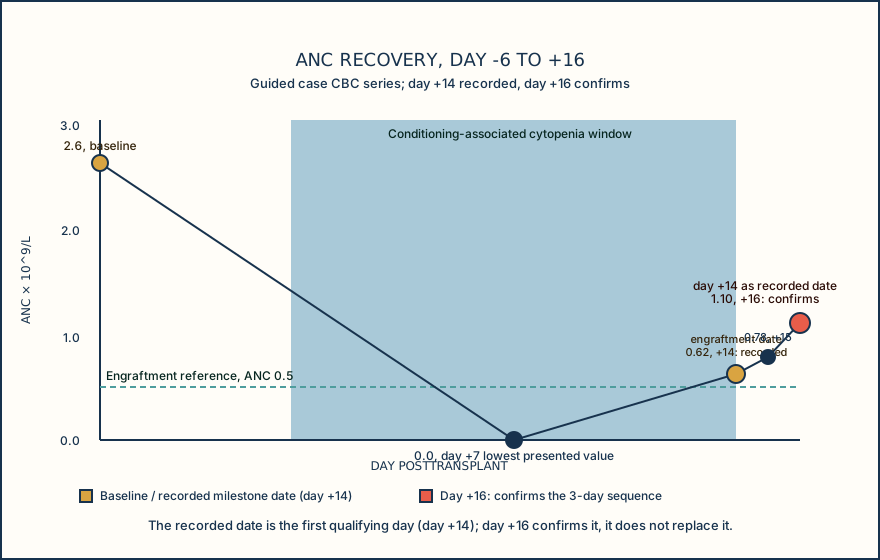
The guided case CBC series starts on day -6 with WBC 4.2 × 10^9/L, ANC 2.6 × 10^9/L, hemoglobin 10.1 g/dL, and platelets 92 × 10^9/L, drawn against the local adult reference interval from EDTA venous whole blood on the same automated hematology analyzer used throughout this case. These values establish the baseline; they are not engraftment evidence, they are the comparison point every later count is read against. On day +7, WBC falls to 0.2 × 10^9/L, ANC to 0.0 × 10^9/L, hemoglobin to 8.4 g/dL, and platelets to 12 × 10^9/L; these are the lowest values in this presented series, not a claim that day +7 is the true nadir of a daily series not shown here. The analyzer flags the ANC and platelet results below its reportable linearity, which routes the specimen to a manual differential and a manual platelet estimate to confirm the automated count before it is released. An ANC of 0.0 × 10^9/L and a platelet count this low also meet the laboratory's critical-result criteria, which requires an immediate verbal report with read-back to the transplant team, documented by name, time, and recipient, independent of whatever the CBC eventually shows on subsequent days. The CBC confirms severe cytopenia at that draw; it does not, by itself, say anything about whether the graft has failed, because a value this low is the expected effect of conditioning in this window, not an unexpected finding.
On day +14, ANC is 0.62 × 10^9/L, the first value at or above the 0.5 × 10^9/L threshold. Under this recovery definition, day +14 is the date that will be recorded for the neutrophil-recovery milestone, but only once it is confirmed: one value meeting a threshold is not yet the three-consecutive-day pattern the program's engraftment definition requires, and there is no second or third day yet in the record to confirm it, so the milestone stays unconfirmed and unrecorded at this point. On day +15, ANC is 0.78 × 10^9/L, the second consecutive qualifying day. On day +16, ANC is 1.10 × 10^9/L, the third consecutive qualifying day, which completes the three-day sequence and confirms day +14, not day +16, as the recorded neutrophil-recovery milestone date. This first-of-three-days convention, confirmed retrospectively by the two following days, matches the American Society for Transplantation and Cellular Therapy's standardized recovery definitions.
Platelet transfusion timing has to be read with the same precision. On day +15, before any transfusion, the 0700 platelet count is 14 × 10^9/L; one unit of apheresis platelets is transfused that afternoon at 1400. On day +16, the 0700 platelet count, drawn about 17 hours after that transfusion, is 19 × 10^9/L. The platelet-recovery definition requires platelets at or above 20 × 10^9/L for three consecutive days without a platelet transfusion in the preceding seven days. The day +16 value is both below the 20 × 10^9/L threshold and inside the seven-day post-transfusion window, so this platelet series cannot be used to record the platelet milestone on either basis. A transfusion-supported count and a count that reflects unsupported marrow recovery are not the same kind of evidence, and reporting them the same way would overstate recovery.
Two disease-monitoring results follow at day +30: a whole-blood short tandem repeat polymerase chain reaction (STR-PCR) chimerism result of 96% donor and 4% recipient, using informative STR markers (loci selected before transplant because the donor and recipient genotypes differ there, so a mixed signal can be attributed to donor versus recipient origin) at a validated analytical sensitivity of about 1% (the smallest minority-population fraction the assay reliably detects above background), and a marrow flow-cytometry MRD result of no abnormal myeloid population detected. That flow-MRD result depends on more than the headline finding: the marrow aspirate specimen is checked for hemodilution (a diluted first-pull specimen can dilute a low-level abnormal population below detection and understate disease), 500,000 viable CD45-positive events were acquired against a local validated 0.1% detection threshold, and the assay's phenotype limits mean it can only recognize the leukemia-associated immunophenotype established at this patient's diagnosis; a relapse with a different or absent phenotype could be missed by this same negative result. These are different specimens and different methods answering different questions. Detectable mixed chimerism on the STR-PCR result does not by itself diagnose relapse, rejection, or graft failure, and a negative flow-MRD result does not erase the chimerism finding, because chimerism measures donor-versus-recipient genetic origin while flow MRD looks for an abnormal leukemic immunophenotype within its own detection and phenotype limits. The two results are read alongside each other, not substituted for each other.
Illustrative drawing — this picture was drawn rather than captured.
| Day | WBC × 10^9/L | ANC × 10^9/L | Hemoglobin g/dL | Platelets × 10^9/L | Note |
|---|---|---|---|---|---|
| -6 | 4.2 | 2.6 | 10.1 | 92 | Baseline, local adult reference interval |
| +7 | 0.2 | 0.0 | 8.4 | 12 | Lowest values in this presented series; analyzer-flagged, manual differential/platelet estimate confirmed, critical result called with read-back |
| +14 | 1.4 | 0.62 | - | 24 | First ANC at or above 0.5; provisional engraftment date pending confirmation, not yet recorded |
| +15 | - | 0.78 | - | 14 (0700, pre-transfusion); 1 unit apheresis platelets transfused 1400 | Second consecutive qualifying ANC day |
| +16 | - | 1.10 | - | 19 (0700, ~17 h post-transfusion) | Third consecutive qualifying ANC day confirms day +14 as the recorded milestone; platelet count is transfusion-supported and not usable for the platelet milestone |
Knowledge checks
Reading and checks are open. Sign in only to save.
Knowledge check 1
Knowledge check 2
Section status
Finish this section
Reading and checks are open. Sign in only to save.
The module finishes after every required section is marked done and every check in those sections is correct.