Required section · Section 3 of 6
What time, temperature, and light actually do
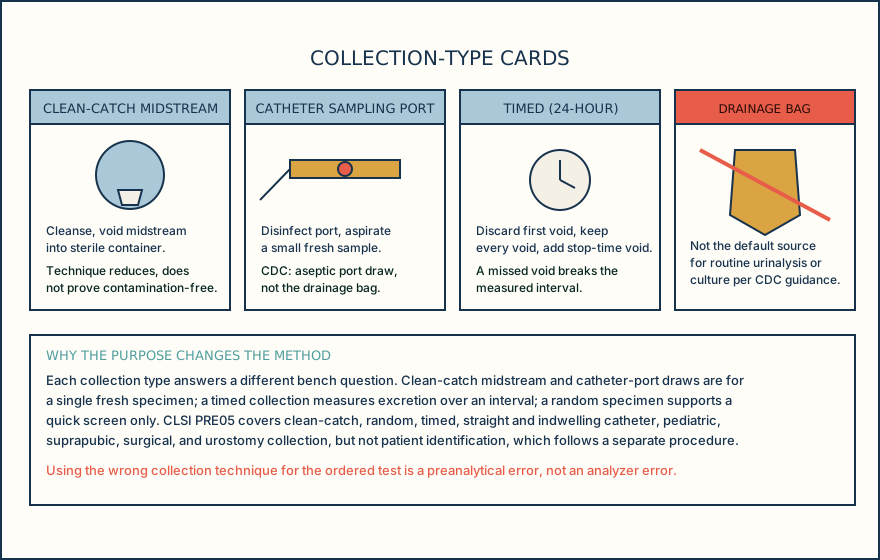
Collection purpose drives collection technique. A clean-catch midstream specimen is cleansed and voided midstream into a sterile container; the technique lowers the chance of contamination but does not certify the result as contamination-free. For a small fresh specimen from an indwelling catheter, CDC directs aseptic collection from the needleless sampling port after disinfecting it. CDC permits drainage-bag collection only for large-volume, non-culture special analyses; it is not the default source for a routine urinalysis or a culture.
A timed collection, most often 24 hours, answers a different question than a single void: total excretion over an interval. The starting void is discarded, every subsequent void is collected, and the void at the stated stop time is included. A missed or spilled void makes the measured total unrepresentative of the stated interval, and total volume, start and stop times, storage condition, and any reported missed void are the facts the laboratory needs to judge the collection.
Delay changes what the laboratory can see. The Roche Combur-Test strip method sheet specifies fresh, well-mixed urine tested within 2 hours at room temperature; that is a manufacturer claim for that strip, not a universal limit for every method. A study of automated urinalysis on pathological specimens found that delay produced statistically significant decreases in white blood cells, red blood cells, casts, and epithelial cells, and shifted dipstick categories for pH, leukocytes, nitrite, protein, ketones, blood, specific gravity, and urobilinogen; the study's own interval does not set a universal acceptance limit for other methods.
The direction of change is not uniform across analytes. Bacterial proliferation and urea conversion during delay can raise pH, though the size and direction depend on the specimen. Cells and casts can deteriorate or dissolve during delay, especially in dilute or alkaline urine, so a negative sediment finding after delay may not reflect the fresh specimen. Glucose can fall through cellular or bacterial metabolism, and ketones can fall through volatility, oxidation, and metabolism. Bilirubin and urobilinogen are light-sensitive; a negative result after light exposure is qualified, not treated as proof of absence. Refrigeration can slow deterioration but can also promote crystal or precipitate formation, so the exact handling before analysis has to be specified in the procedure, and any preservative tube must be matched to the analytes it was validated to protect.
CAP requires the laboratory to define and follow written criteria for rejecting or specially handling specimens that fail those criteria, and to document the condition and disposition of any specimen that is tested anyway with a caution to the ordering clinician. That requirement is what turns the biology above into a laboratory action.
A delayed or unpreserved specimen can look unremarkable on paper and still misrepresent the patient at the moment of collection.
Illustrative drawing — this picture was drawn rather than captured.
| Analyte or finding | Common direction with delay | Mechanism |
|---|---|---|
| pH | Tends to rise | Bacterial urea conversion and proliferation during storage |
| Glucose | Tends to fall | Cellular and bacterial metabolism, worse with bacteriuria |
| Ketones | Tends to fall | Volatility, oxidation, and metabolism during storage |
| Bilirubin and urobilinogen | Tends to fall with light exposure | Photo-oxidation of light-sensitive analytes |
| Cells and casts | Tend to decrease or dissolve | Lysis, especially in dilute or alkaline urine |
| Bacteria count | Tends to rise | Proliferation at room temperature |
Ordering exercise
Place these steps of a 24-hour timed urine collection in the correct sequence, from the start of the collection period to its documentation.
1. Document total volume and any missed void
The laboratory records total volume, start and stop times, storage condition, and any reported missed or spilled void before evaluating the collection.
2. Include the void at the stop time
The final void, at the stated stop time exactly 24 hours later, is added to the collection to close the interval.
3. Collect every subsequent void
Every void during the 24-hour period is added to the collection container, refrigerated or preserved as the procedure specifies.
4. Discard the first void
The patient voids at the start time and that void is discarded; it represents urine formed before the interval began.
Knowledge checks
Reading and checks are open. Sign in only to save.
Knowledge check 1
Knowledge check 2
Knowledge check 3
Section status
Finish this section
Reading and checks are open. Sign in only to save.
The module finishes after every required section is marked done and every check in those sections is correct.