Required section · Section 4 of 6
Working the guided pleural case
The specimen from the opening problem is a thoracentesis at 10:02, received 10:10, opaque yellow, with no clot. The EDTA aliquot yields a total nucleated cell count of 1,240 cells per microliter with a differential of 72% neutrophils. The absolute neutrophil count is 1,240 multiplied by 0.72, which equals 893 cells per microliter, a calculated value rather than a directly counted one.
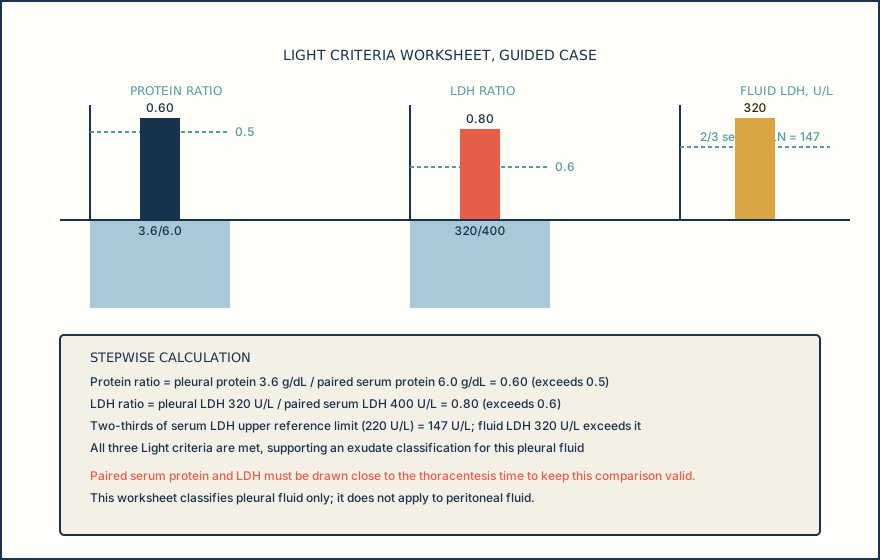
Pleural protein is 3.6 g/dL against a paired serum protein of 6.0 g/dL, drawn at 10:18. The protein ratio is 3.6 divided by 6.0, which equals 0.60, above the 0.5 exudate threshold. Pleural LDH is 320 U/L against a paired serum LDH of 400 U/L, giving a ratio of 320 divided by 400, or 0.80, above the 0.6 threshold. The adult serum LDH reference interval upper limit is 220 U/L, so two-thirds of that upper limit is 147 U/L; the pleural LDH of 320 U/L exceeds that value as well.
All three Light criteria are met in this case, so the fluid is classified as an exudate. Only one criterion has to be met for that classification, but seeing all three line up here makes the ratio math and the absolute-LDH comparison easier to hold side by side. None of this classification transfers to a peritoneal specimen; if this same patient later has ascites sampled, that fluid needs its own framework, most commonly the serum-ascites albumin gradient rather than a protein or LDH ratio.
The pleural pH was 7.28, drawn anaerobically into a heparinized blood-gas syringe with no air bubble and run at 10:18, sixteen minutes after collection. A result in that range falls into an intermediate-risk band in one professional society's pleural-infection pathway, where pH at or below 7.20 is described as high risk and pH at or above 7.40 as low risk, and an intermediate value is meant to be read together with LDH and the rest of the clinical picture rather than acted on alone. Residual liquid heparin or lidocaine in the syringe can lower a measured pH, and air exposure can raise it, so the clean, prompt collection in this case is what makes the 7.28 usable at all.
Show the ratio math, the units, and the timing on every paired calculation, because a reviewer needs to see whether the fluid and serum samples were drawn close enough together to trust the ratio.
Illustrative drawing — this picture was drawn rather than captured.
| Result | Value | Reference or decision context | Flag |
|---|---|---|---|
| Pleural total nucleated cells | 1,240 cells/uL | No universal fluid reference range | None |
| Neutrophils | 72% | Differential percentage | None |
| Calculated absolute neutrophils | 893 cells/uL | 1,240 x 0.72 | Calculated |
| Pleural protein | 3.6 g/dL | Matrix claim confirmed locally | None |
| Paired serum protein, 10:18 | 6.0 g/dL | Adult serum result | None |
| Pleural LDH | 320 U/L | Matrix claim confirmed locally | None |
| Paired serum LDH, 10:18 | 400 U/L | Adult reference interval 140-220 U/L | High |
| Pleural pH | 7.28 | Intermediate-risk band, not a diagnosis | Time-sensitive |
| Pleural glucose | 68 mg/dL | Matrix claim confirmed locally | None |
Knowledge checks
Reading and checks are open. Sign in only to save.
Knowledge check 1
Knowledge check 2
Knowledge check 3
Section status
Finish this section
Reading and checks are open. Sign in only to save.
The module finishes after every required section is marked done and every check in those sections is correct.