Required section · Section 3 of 6
The Variables That Change the Answer
Liquefaction and viscosity are assessed before anything else, because an unliquefied specimen cannot be pipetted or counted accurately. The World Health Organization describes normal liquefaction as usually complete within 15 to 30 minutes at room temperature, and incomplete liquefaction at both the 30-minute and 60-minute marks should be recorded rather than waited out silently. CAP requires that every semen specimen be given sufficient time to liquefy before testing, and that macroscopic and microscopic characteristics such as gelatinous clumps, viscosity, contaminants, and erythrocytes be noted on the report.
Viscosity is a separate property from liquefaction: after liquefaction, the laboratory observes the thread that forms as semen falls from a wide-bore pipette or glass rod, and a thread longer than roughly 2 cm is recorded as increased viscosity even in a fully liquefied specimen. CAP also requires the specimen to be mixed thoroughly before any testing step, since sperm settle unevenly in a standing sample.
Temperature matters because motility is temperature-dependent; a specimen that cools during handling can lose motile sperm before you ever load a chamber. The transport temperature range, 20 to 27 degrees C, is this laboratory's own validated range, not a value fixed by CAP or the World Health Organization; a real bench procedure states and revalidates its own range rather than borrowing one from a textbook.
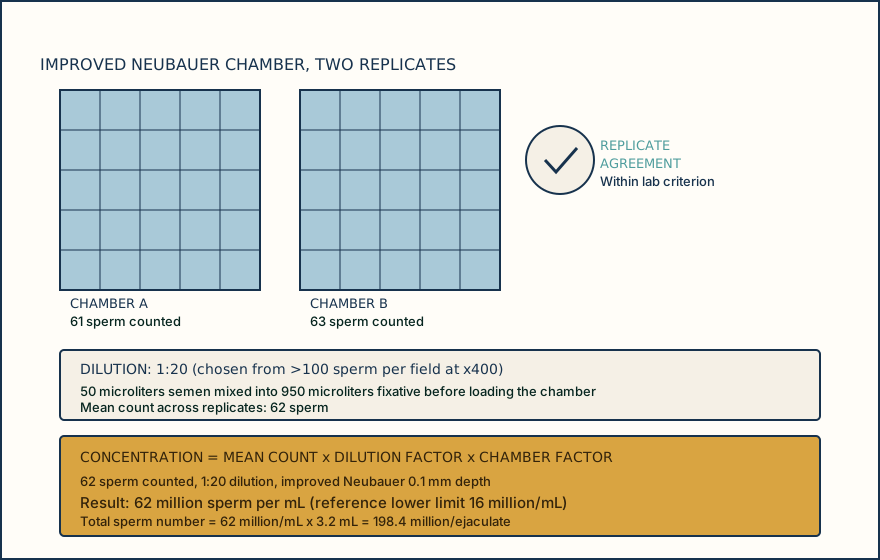
Concentration and total sperm number are counted on an improved Neubauer hemocytometer. The World Health Organization's protocol chooses a dilution scheme from the approximate sperm density seen at 400x magnification, so a denser specimen gets a higher dilution before counting, and the target is roughly 200 sperm counted per replicate to keep counting error acceptable.
When a laboratory instead uses an automated computer-assisted semen analysis (CASA) system, automated-method material is kept generic because a real procedure has to name and cite the specific validated instrument's manufacturer instructions, which vary by platform.
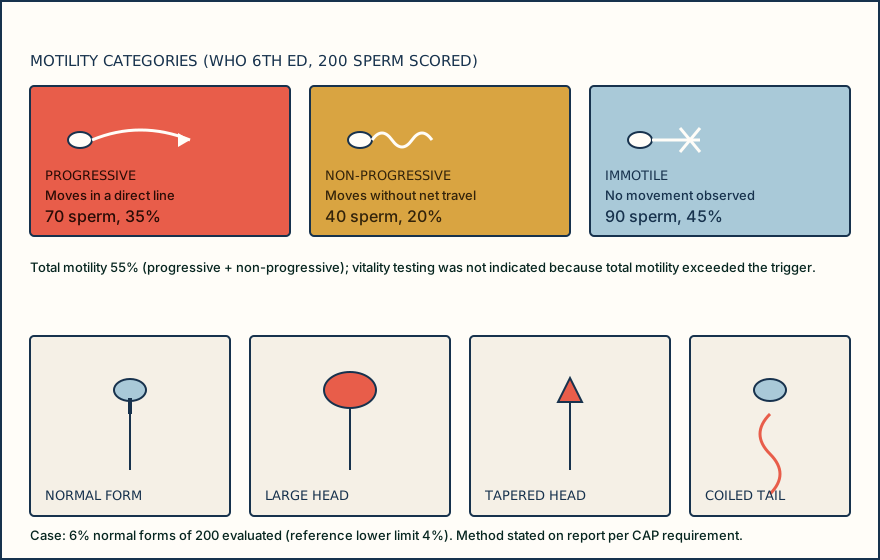
Motility is classified using current World Health Organization sixth-edition terminology, which reintroduced four categories: rapid progressive (fast, mostly straight-line or large-circle movement), slow progressive (slower but still net forward movement), non-progressive (active tail movement without meaningful net displacement), and immotile (no movement at all). Progressive motility is rapid progressive plus slow progressive, and total motility is progressive plus non-progressive; immotile is reported separately and is not part of either sum. This replaces the older letter-graded a-through-d scheme in name only, since rapid progressive and slow progressive correspond to the old grades a and b. CAP requires motility percent and progression to be evaluated within one hour of collection, with any exception documented.
Vitality testing distinguishes live but immotile sperm from dead sperm, most often with a dye-exclusion stain such as eosin-nigrosin, and matters because a specimen with very low motility could still contain a meaningful fraction of live, non-motile sperm. The World Health Organization's commentary indicates vitality assessment when total motility falls below 40 percent. CAP's own checklist gives a different trigger, less than 30 percent, and requires either that testing be performed at that point or that the report carry a comment noting that decreased motility may reflect non-viable or non-motile sperm. The two numbers are not the same, and both are stated rather than picking one as definitive; the laboratory director sets and documents the specific percentage used locally.
Morphology is evaluated on a stained smear under strict (Kruger-derived) criteria as adopted in the current World Health Organization edition, never on an unstained preparation. Because different morphology classification systems carry different normal ranges, CAP requires the classification method used to be stated on the report.
Every microscopic parameter rides on a written, validated method and a stated timing window; a number without its method and its clock attached is not a complete result.
Illustrative drawing — this picture was drawn rather than captured.
Illustrative drawing — this picture was drawn rather than captured.
| Parameter | Unit | WHO lower reference limit |
|---|---|---|
| Volume | mL | 1.4 |
| Sperm concentration | million/mL | 16 |
| Total sperm number | million/ejaculate | 39 |
| Total motility | % | 42 |
| Progressive motility | % | 30 |
| Vitality | % | 54 |
| Normal morphology (strict criteria) | % | 4 |
Knowledge checks
Reading and checks are open. Sign in only to save.
Knowledge check 1
Knowledge check 2
Knowledge check 3
Section status
Finish this section
Reading and checks are open. Sign in only to save.
The module finishes after every required section is marked done and every check in those sections is correct.