Required section · Section 4 of 6
Guided Example: Working One Complete Case
Collection history: 3 days of abstinence, specimen collected by masturbation into a sterile wide-mouth container at the collection site, delivered to the laboratory at 09:05, 35 minutes after collection and within this laboratory's validated 20-to-27-degree-C transport range, entire ejaculate reported captured with no visible loss of the first fraction. That history clears the pre-analytic requirements: abstinence within the 2-to-7-day window, a complete collection, and delivery inside the 30-to-60-minute transport window.
Macroscopic exam: liquefaction complete at 25 minutes at room temperature, inside the usual 15-to-30-minute window. Volume 3.2 mL against a lower reference limit of 1.4 mL. Appearance gray-white. Viscosity normal, with short discrete drops from the pipette and no thread over 2 cm. The specimen was mixed thoroughly before any further testing.
Concentration: an improved Neubauer chamber loaded at a 1:20 dilution (50 microliters of semen in 950 microliters of fixative), chosen because more than 100 sperm per field were seen at 400x. Sperm were dense enough that only the central 1 mm by 1 mm grid, 0.1 mm deep, was counted in each chamber: one grid per chamber holds 0.1 microliter, so two chambers give a total counted volume of 0.2 microliter. Two replicate chambers counted 198 and 202 sperm, a mean of 200 per replicate, meeting this method's roughly-200-per-replicate precision target and in agreement by the laboratory's replicate criterion. Concentration is the total count times the dilution factor, divided by the counted volume in microliters times 1000 to convert to sperm per mL: (400 x 20) / (0.2 x 1000) = 8,000 / 200 = 40 million sperm per mL, against a lower reference limit of 16 million per mL. Total sperm number is concentration multiplied by volume: 40 million/mL times 3.2 mL equals 128 million sperm for the ejaculate, against a lower reference limit of 39 million.
Motility, scored 40 minutes after collection and therefore inside CAP's one-hour window: of 200 sperm assessed, 50 were rapid progressive (25 percent), 20 slow progressive (10 percent), 40 non-progressive (20 percent), and 90 immotile (45 percent). Progressive motility (rapid plus slow progressive) is 70 sperm, 35 percent, against a lower reference limit of 30 percent. Total motility (progressive plus non-progressive) is 110 sperm, 55 percent, against a lower reference limit of 42 percent. Because total motility sits above the laboratory's vitality-testing trigger, vitality testing was not performed on this specimen, and CAP's own less-than-30-percent example was not met either.
Morphology on a stained smear under World Health Organization strict criteria: 6 percent normal forms of 200 sperm evaluated, against a lower reference limit of 4 percent; the classification method (strict criteria) is stated on the report as CAP requires. Round cells and leukocytes measured 0.3 million per mL, below the concentration that raises leukocytospermia concern, and the laboratory's procedure did not call for a confirmatory stain to differentiate leukocytes from other round cells on this report. No agglutination was observed.
Every parameter in this case meets or exceeds its own WHO lower reference limit, and progressive motility carries the smallest margin above its limit of the six parameters checked. That margin is exactly the kind of detail a single result set cannot resolve by itself: biological variability between ejaculates from the same person is well documented, so this specimen's numbers describe this collection, not a fixed trait of the patient. Work every semen parameter back to its own reference limit and its own unit before comparing results across parameters; a percentage and a concentration are not interchangeable just because both look like numbers on the same line.
Illustrative drawing — this picture was drawn rather than captured.
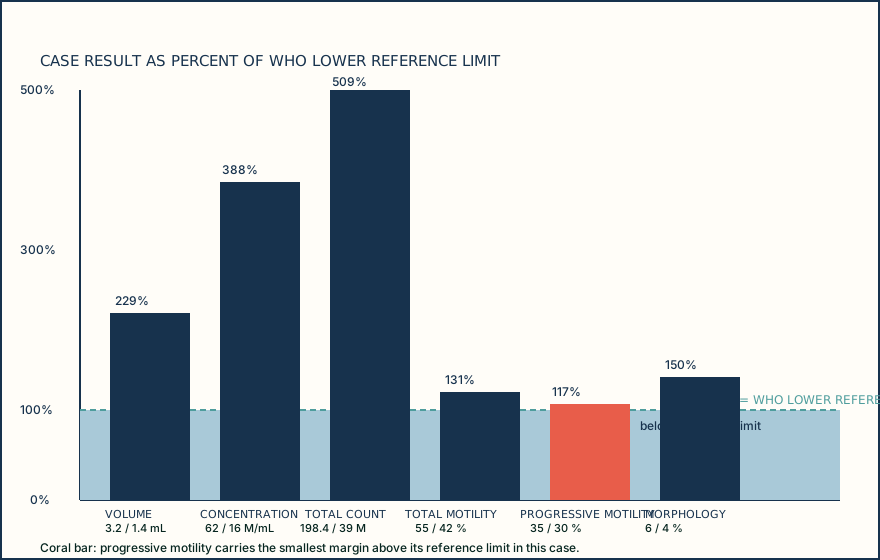
| Parameter | Case result | WHO lower reference limit | Meets limit |
|---|---|---|---|
| Volume | 3.2 mL | 1.4 mL | Yes |
| Concentration | 40 million/mL | 16 million/mL | Yes |
| Total sperm number | 128 million | 39 million | Yes |
| Total motility | 55% | 42% | Yes |
| Progressive motility | 35% | 30% | Yes |
| Normal morphology (strict) | 6% | 4% | Yes |
| Category | Count | Percent |
|---|---|---|
| Rapid progressive | 50 | 25% |
| Slow progressive | 20 | 10% |
| Progressive (rapid + slow) | 70 | 35% |
| Non-progressive | 40 | 20% |
| Immotile | 90 | 45% |
| Total motility (progressive + non-progressive) | 110 | 55% |
Knowledge checks
Reading and checks are open. Sign in only to save.
Knowledge check 1
Knowledge check 2
Section status
Finish this section
Reading and checks are open. Sign in only to save.
The module finishes after every required section is marked done and every check in those sections is correct.