Required section · Section 2 of 6
The analytic path, in order
Every automated chemistry result travels the same general sequence, whatever the analyte or the instrument brand. The analyzer first identifies the specimen and matches it to an order. It then aspirates a precise volume of specimen and reagent. The mixture reacts under controlled temperature and timing. A detector reads a physical or chemical signal produced by that reaction. Software converts the signal to a concentration or activity using a stored calibration curve. Flags and range checks are applied, and the result is released to the report only after control and consistency checks pass.
Four roles travel this same path without overlapping on a single specimen measurement. The patient specimen is the unknown material being measured. The reagent is the chemistry that reacts with the analyte to produce a measurable signal. The calibrator is a material with an assigned, known value that establishes or adjusts the signal-to-result relationship for that run. The control is an assayed material with assigned values and acceptable ranges; it verifies that the whole system is performing as expected, but the operator does not adjust the method toward the control result. Treating a control as a calibrator breaks the measurement trace rather than merely mislabeling a tube.
The diagram below gives you one reusable picture of this path. Later sections refer back to one or more of these seven stages: identify, aspirate, react, detect, calculate, flag, verify and release.
Calibration, calibration verification, and quality control answer three different questions. Calibration establishes or adjusts the signal-to-result relationship. Calibration verification confirms recovery across the reportable range according to the manufacturer instructions and laboratory procedure. QC monitors current performance. Under CLIA, required calibration, verification, or control that is unacceptable must prevent patient-result release; the jurisdictional floor is not a universal method schedule or universal number of levels.
If you can name the stage a result is in, you know what has and has not yet been checked for that specimen.
Illustrative drawing — this picture was drawn rather than captured.
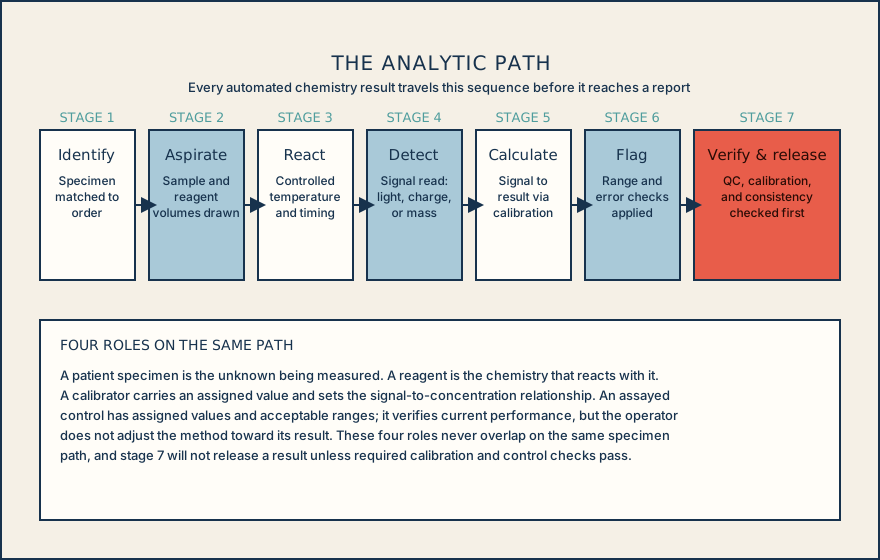
The seven-stage analytic path every automated chemistry result travels
Identify
The analyzer reads the specimen identifier and matches it to a pending order before any liquid moves.
Aspirate
A precise volume of specimen and a precise volume of reagent are drawn into the reaction vessel.
React
The mixture reacts under controlled temperature and timing specific to the method.
Detect
A detector reads a physical or chemical signal produced by the reaction: light, electrical potential, emitted light, or mass-to-charge ratio.
Calculate
Software converts the raw signal into a concentration or activity using the stored calibration curve for that method.
Flag
The result is checked against instrument error conditions, the analytical measuring range, and other rule-based criteria.
Verify and release
Calibration status, control status, and any autoverification rules for the run are checked before the result reaches the report.
Ordering exercise
Seven event cards from a run record are shown out of order. Place them in the sequence the analyzer actually performs them.
1. Verify and release
Control and calibration status are checked before the result reaches the report.
2. Detect
The detector reads the physical or chemical signal produced.
3. Identify
Specimen barcode is scanned and matched to the pending order.
4. Calculate
The signal is converted to a concentration using the calibration curve.
5. React
The reaction proceeds under controlled temperature and timing.
6. Aspirate
Specimen and reagent volumes are drawn into the reaction vessel.
7. Flag
The calculated result is checked against instrument and range criteria.
Knowledge checks
Reading and checks are open. Sign in only to save.
Knowledge check 1
Knowledge check 2
Section status
Finish this section
Reading and checks are open. Sign in only to save.
The module finishes after every required section is marked done and every check in those sections is correct.