Required section · Section 2 of 6
Read filtration and albuminuria as two axes
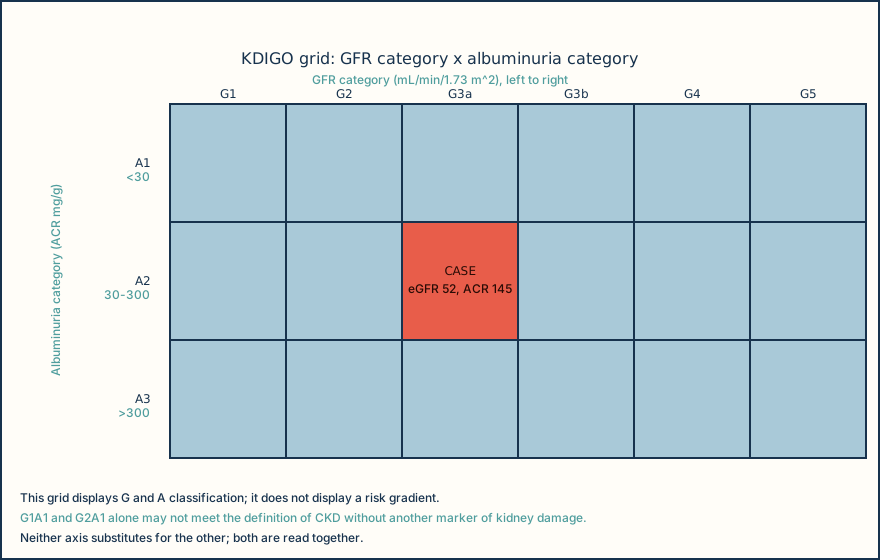
KDIGO classification uses GFR category and albuminuria category as two independent axes, with cause considered separately. G1 is at least 90 and G5 is below 15 mL/min/1.73 m^2. A1 is below 30, A2 is 30-300, and A3 is above 300 mg/g ACR.
The grid displays two classifications: eGFR 52 is G3a and ACR 145 is A2. It does not display a risk gradient. This placement supports a pattern, not a diagnosis from one draw.
G1A1 and G2A1 alone may not meet the definition of CKD without another marker of kidney damage. CKD also requires three months of persistence or other chronicity evidence. Assign G and A categories before reading the combined cell.
Illustrative drawing — this picture was drawn rather than captured.
Reusable integration sequence
Assign G category
Use reported adult eGFR.
Assign A category
Use ACR.
Place the grid cell
Read both axes together.
Review urine evidence
Use protein, blood, cells, and casts to localize or challenge the pattern.
Knowledge checks
Reading and checks are open. Sign in only to save.
Knowledge check 1
Knowledge check 2
Section status
Finish this section
Reading and checks are open. Sign in only to save.
The module finishes after every required section is marked done and every check in those sections is correct.