Required section · Section 2 of 6
Three electrodes in the illustrated configuration
In the illustrated electrode configuration, pH, PCO2, and PO2 are directly measured. Other configured systems can directly measure additional analytes. In this illustrated configuration, bicarbonate, base excess, total CO2, and estimated oxygen saturation are calculated from the measured values and stored constants. Bicarbonate is not sensed by a dedicated electrode here; it is derived from measured pH and PCO2 through the Henderson-Hasselbalch relationship. Label calculated results on the report so they are not mistaken for direct measurements.
The pH electrode is a hydrogen-ion-selective glass membrane. Hydrogen-ion activity across the membrane generates a small voltage, and the analyzer converts that voltage to a pH value by comparing it against a reference electrode. The PO2 electrode, a Clark or polarographic electrode, works on a different principle: oxygen diffuses across an oxygen-permeable membrane to a platinum cathode, is electrochemically reduced, and the resulting current is proportional to PO2. This is an amperometric measurement, current in proportion to concentration, not a voltage measurement.
The PCO2 electrode, a Severinghaus electrode, measures PCO2 indirectly. Carbon dioxide diffuses across a membrane into a bicarbonate buffer solution, generates hydrogen ions in proportion to how much CO2 arrived, and a glass pH electrode inside that buffer reads the resulting pH shift. The analyzer converts that pH shift back into a PCO2 value. In other words, the PCO2 electrode is a pH electrode wrapped in chemistry that makes it respond to carbon dioxide instead of the specimen's own pH.
Every measured value on a standard blood gas panel is warmed to and read at 37 degrees C inside the analyzer, regardless of the patient's actual body temperature. If the report also shows temperature-corrected values, those are an algorithmic adjustment applied to the 37-degree measurement, not a second physical measurement taken at the patient's temperature.
The process map below separates the electrode module from the calculation engine so the two never blur together on a busy shift. If a value did not come from a dedicated electrode, it is calculated, and it inherits whatever error already existed in the measurements it was built from.
Illustrative drawing — this picture was drawn rather than captured.
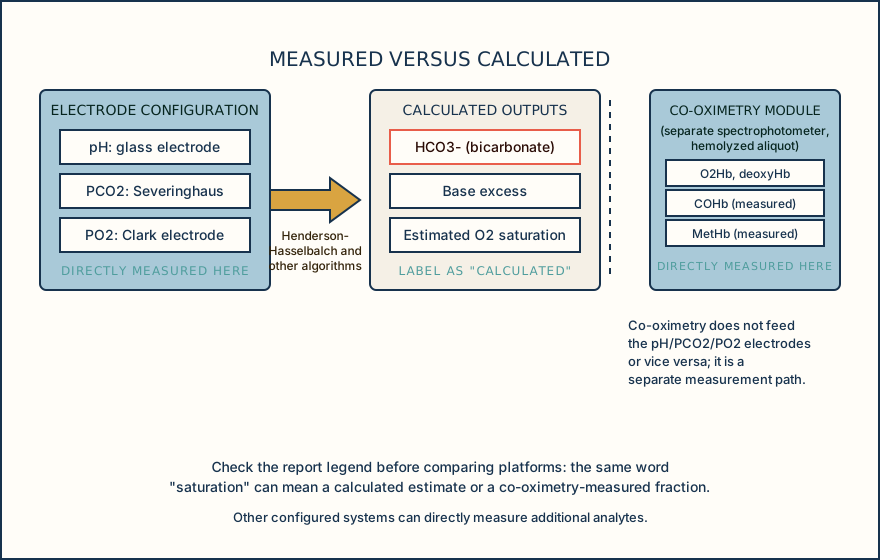
From electrode signal to a labeled report value
Electrode generates a physical signal
The pH glass membrane produces a voltage, the PO2 Clark electrode produces a reduction current, and the PCO2 Severinghaus electrode produces a pH shift in its internal buffer.
Analyzer converts signal to a measured value
In the illustrated electrode configuration, firmware converts each raw signal into pH, PCO2, and PO2 using the current calibration curve. Other configured systems can directly measure additional analytes.
Software calculates derived values
Bicarbonate, base excess, total CO2, and an estimated oxygen saturation are computed from the measured pH, PCO2, and PO2 using stored formulas, not sensed independently.
Report labels each value's origin
The printed or displayed report marks calculated values as calculated so a reader does not mistake calculation for a direct electrode reading.
Knowledge checks
Reading and checks are open. Sign in only to save.
Knowledge check 1
Knowledge check 2
Knowledge check 3
Section status
Finish this section
Reading and checks are open. Sign in only to save.
The module finishes after every required section is marked done and every check in those sections is correct.