Required section · Section 2 of 6
DIC as a moving process, not a snapshot
Disseminated intravascular coagulation (DIC) is an acquired intravascular disorder in which coagulation is activated systemically, fibrinolysis becomes dysregulated, the endothelium is injured, and small vessels accumulate microthrombi. It is not a fixed lab result pattern that appears all at once. DIC can progress from an early phase, which may be asymptomatic or show only subtle screening changes, toward frank hemorrhage, organ dysfunction, or both. Because the process moves, a single panel is a snapshot of a point on a moving curve, and serial results are more informative than any one panel.
As coagulation activates, platelets and fibrinogen are consumed faster than they are replaced, so their counts and levels tend to fall on serial draws. At the same time, fibrin is generated and then degraded by plasmin, releasing fibrin degradation products including D-dimer, so D-dimer tends to rise. PT and aPTT, which measure how quickly plasma clots after specific activators are added, tend to prolong as clotting factors and fibrinogen are consumed. None of these four analytes is specific for DIC on its own; the pattern is what the mental model is built around, and the pattern is only interpretable inside a patient who has an associated clinical condition, such as sepsis, trauma, malignancy, or an obstetric event. A DIC pattern is never read from laboratory results alone.
This process view has a direct bench consequence: a fibrinogen value that is still inside the reference interval does not exclude an active consumption process, because fibrinogen is also an acute-phase reactant that rises with inflammation before it falls with consumption. A falling trend, even one that starts above the interval and ends inside or below it, carries more information than either value read in isolation.
Read platelet count, fibrinogen, PT, aPTT, and D-dimer as a set moving through time inside a stated clinical setting, not as four independent flags.
Illustrative drawing — this picture was drawn rather than captured.
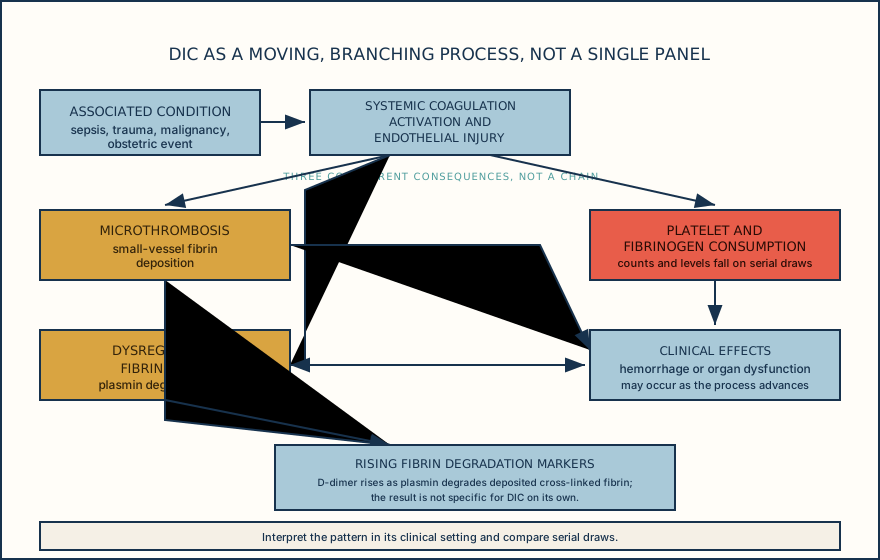
The DIC process branching from an associated clinical condition and systemic activation into concurrent microthrombosis, consumption, and dysregulated fibrinolysis. Microthrombosis and fibrinolysis drive rising fibrin markers, while all three processes contribute to clinical effects.
Associated clinical condition
Sepsis, trauma, malignancy, or an obstetric event provides the trigger; a DIC pattern is only interpreted inside a stated clinical setting.
Systemic coagulation activation and endothelial injury
Coagulation is activated intravascularly and the endothelium is injured, branching into the three concurrent processes that follow rather than a single next step.
Microthrombosis
Fibrin is deposited in small vessels as one of three concurrent consequences of activation, contributing to organ dysfunction as the process advances.
Platelet and fibrinogen consumption
Platelets and fibrinogen are used faster than replaced as a second concurrent consequence of activation, so counts and levels fall on serial draws even from a normal starting point.
Dysregulated fibrinolysis
Plasmin degrades cross-linked fibrin in an unregulated way as a third concurrent consequence of activation, proceeding alongside microthrombosis and consumption rather than after them.
Rising fibrin degradation markers
D-dimer and related fibrin degradation products rise as plasmin degrades deposited cross-linked fibrin; the rise supports fibrin formation and breakdown but is not specific for DIC.
Hemorrhage or organ dysfunction
Microthrombosis, consumption, and dysregulated fibrinolysis each contribute to the clinical picture; depending on which predominates, the patient can progress toward bleeding, organ dysfunction, or both, and not necessarily in a fixed order.
Knowledge checks
Reading and checks are open. Sign in only to save.
Knowledge check 1
Section status
Finish this section
Reading and checks are open. Sign in only to save.
The module finishes after every required section is marked done and every check in those sections is correct.