Required section · Section 6 of 6
What this trend supports, and what it does not
The 07:30-to-13:30 trend in this case supports an evolving acquired consumption pattern: platelets and fibrinogen falling together while PT, aPTT, and D-dimer rise together, in a patient with a stated clinical setting compatible with DIC. That is the pattern the evidence supports. It is not a diagnosis of DIC, which requires an eligible clinical setting and, where locally adopted, a scoring framework applied with the current published criteria and the laboratory's own assay units.
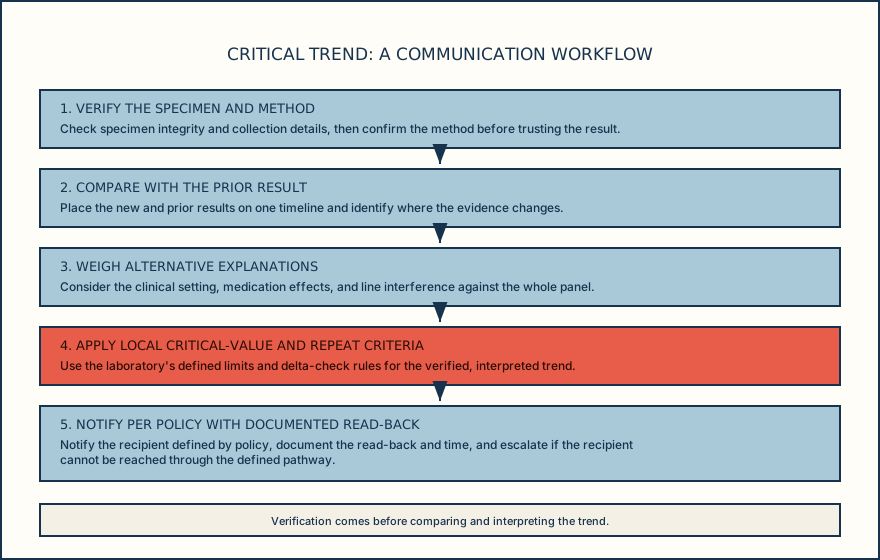
What depends on method and local policy is substantial: the exact reference intervals, the D-dimer ULN and units, whether the 2025 ISTH framework is adopted locally and for which patients, the critical-value and delta-check thresholds, the notification recipients and escalation timeline, and the specimen rejection and recollection rules. None of those are universal coagulation facts; verify each one against your laboratory's validated procedures before applying anything here at the bench.
The rare schistocytes in this case are a corroborating finding, not a standalone conclusion. TMA and DIC can overlap in early presentations, and relative preservation of PT, aPTT, and fibrinogen favors TMA over consumption, while the more involved coagulation panel here favors an evolving consumption pattern; a normal-looking screen never excludes early DIC on its own, and a hemolysis workup is the next step to sharpen that distinction.
Report what the trend shows, name the pattern it supports with its uncertainty stated directly, and hand the diagnostic and treatment decision to the clinical team while you route anything meeting your policy's urgent-communication criteria without delay.
Illustrative drawing — this picture was drawn rather than captured.
Knowledge checks
Reading and checks are open. Sign in only to save.
Knowledge check 1
Section status
Finish this section
Reading and checks are open. Sign in only to save.
The module finishes after every required section is marked done and every check in those sections is correct.