Required section · Section 4 of 6
Working the 07:30 and 13:30 panels
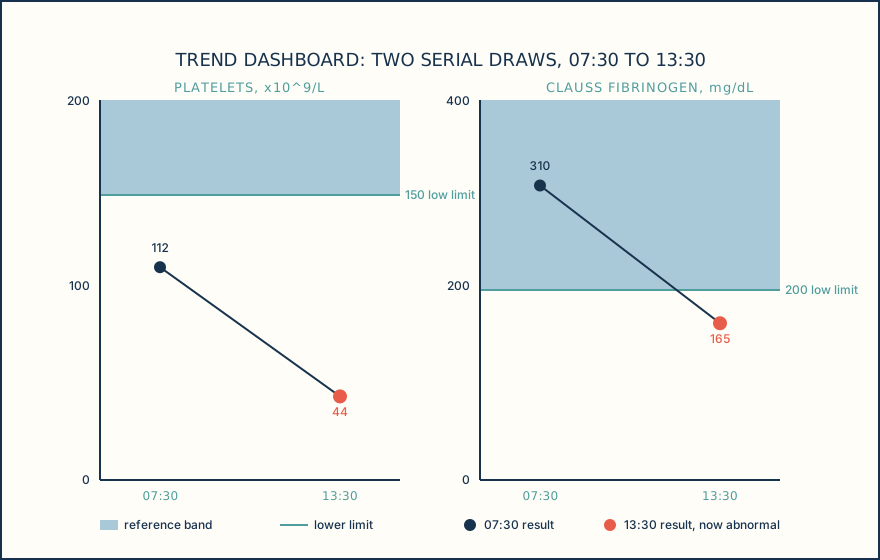
Return to the opening panels. Platelets fall from 112 to 44 x10^9/L (reference 150-400, now low). PT rises from 15.2 to 19.0 seconds (reference 11.5-14.5, now high) and INR from 1.2 to 1.7. aPTT rises from 34 to 48 seconds (reference 25-35, now high). Clauss fibrinogen falls from 310 to 165 mg/dL, crossing from normal to low against a 200-400 mg/dL interval. D-dimer rises from 1,400 to 4,500 ng/mL FEU against a local upper limit of normal (ULN) of 500 ng/mL FEU.
Creatinine rises from 1.0 to 1.6 mg/dL, and the 13:30 smear shows rare schistocytes with a platelet estimate concordant with the automated count. Optical clot detection was used for PT, aPTT, and fibrinogen on both draws, and the second specimen was newly drawn and fully filled, so a specimen-quality explanation for the delta is less likely, though it is never assumed without checking. The medication administration record shows no heparin, argatroban, or other anticoagulant given between the two draws, and the collection log documents both specimens as peripheral venipunctures rather than draws from the patient's central line. The aPTT prolongation also tracks with the PT prolongation rather than running far ahead of it, which is the opposite of the disproportionate aPTT-over-PT signature a heparin or line-flush effect would produce.
With medication, line source, and anticoagulant timing checked and ruled out, the coherent change across six hours is a falling platelet count and fibrinogen together with rising PT, aPTT, and D-dimer, in a patient with a documented severe systemic inflammatory illness. That combination supports an acquired consumption pattern. It does not, by itself, diagnose DIC; a DIC pattern is read only inside an eligible clinical setting, and this discussion stops at describing the supported pattern and the evidence that would extend or contradict it. The rare schistocytes require correlation with the hemolysis workup (lactate dehydrogenase, haptoglobin) before a TMA contribution can be discussed, and they do not by themselves establish thrombotic microangiopathy.
The 2025 ISTH overt-DIC framework, where currently and locally adopted, scores four elements in an eligible patient: platelet count (50 to less than 100 x10^9/L = 1 point, less than 50 = 2), D-dimer relative to the assay ULN (greater than 3 to 7 times ULN = 2, greater than 7 times = 3), PT prolongation above the local control or reference basis (3 to less than 6 seconds = 1, 6 seconds or more = 2), and fibrinogen (less than 100 mg/dL = 1).
Applying a local D-dimer ULN of 500 ng/mL FEU to the 13:30 draw: platelets less than 50 = 2 points, D-dimer at 9 times ULN = 3 points, PT prolonged 4.5 seconds above the upper reference limit = 1 point, and fibrinogen 165 mg/dL is not below 100 mg/dL = 0 points, for a total of 6.
A total of 5 or more is compatible with overt DIC under this framework, but the score is only meaningful if the local laboratory has adopted this current framework, the patient meets its clinical eligibility criteria, and the assay-specific ULN is verified; it is a framework, not a replacement for reviewing the clinical setting, assay units, and serial trend.
Work the trend first, name the pattern the trend supports, and treat any current score as a structured summary of that same evidence, not as a separate independent answer.
Illustrative drawing — this picture was drawn rather than captured.
| Result | 07:30 | 13:30 | Adult reference interval or flag |
|---|---|---|---|
| Platelets | 112 x10^9/L | 44 x10^9/L | 150-400, low |
| PT | 15.2 s | 19.0 s | 11.5-14.5, high |
| INR | 1.2 | 1.7 | 0.9-1.1, high |
| aPTT | 34 s | 48 s | 25-35, high |
| Clauss fibrinogen | 310 mg/dL | 165 mg/dL | 200-400, falling then low |
| D-dimer | 1,400 ng/mL FEU | 4,500 ng/mL FEU | less than 500, high |
| Creatinine | 1.0 mg/dL | 1.6 mg/dL | 0.6-1.3, rising |
| Smear | no fragments reported | rare schistocytes, concordant platelet estimate | manual review requested |
| Element | 13:30 value | Points |
|---|---|---|
| Platelet count | 44 x10^9/L (less than 50) | 2 |
| D-dimer vs ULN | 4,500 ng/mL FEU, 9x ULN (greater than 7x) | 3 |
| PT prolongation | 4.5 s above upper reference limit (3 to less than 6 s) | 1 |
| Fibrinogen | 165 mg/dL (not less than 100) | 0 |
| Total | Compatible with overt DIC only if framework is locally adopted and patient is eligible | 6 |
Knowledge checks
Reading and checks are open. Sign in only to save.
Knowledge check 1
Knowledge check 2
Section status
Finish this section
Reading and checks are open. Sign in only to save.
The module finishes after every required section is marked done and every check in those sections is correct.