Required section · Section 4 of 6
Working the guided case
A citrated, platelet-poor plasma specimen was collected at 09:10 with no clot or hemolysis flag, and residual platelet count was below the local limit. Medication review before release showed no anticoagulant reported. PT was 11.8 seconds against a 10.5 to 13.5 second range, unremarkable, which lowers concern for a broad factor deficiency.
The routine aPTT was 48.2 seconds against a 25.0 to 35.0 second range, prolonged. The dRVVT screen was 62.0 seconds against a 30.0 to 44.0 second range, also prolonged. The dRVVT confirm, using the high-phospholipid reagent, shortened to 38.0 seconds, within its own 29.0 to 38.0 second range. The resulting dRVVT normalized screen-to-confirm ratio was 1.42, above the local positive cutoff of greater than 1.20. The silica-based system showed the same pattern: a normalized screen-to-confirm ratio of 1.28, above its local positive cutoff of greater than 1.16.
The dRVVT 1:1 mix screen was 52.0 seconds, above the local mix cutoff of 45.0 seconds, so the mix did not fully correct. That supports an inhibitor, but a weak inhibitor can dilute out in a mix, so this step is read alongside the confirm ratio rather than in isolation. CRP and factor VIII were not available for this specimen, so an acute-phase contribution cannot be assessed and that gap belongs in the report as a stated limitation, not a silent assumption.
Both assay systems show an abnormal screen and an abnormal, disproportionate confirm ratio, which is consistent with phospholipid dependence. With no known anticoagulant and adequate specimen preparation, a defensible release states: results support a phospholipid-dependent inhibitor pattern consistent with lupus anticoagulant by dRVVT and silica clotting time systems; this laboratory result does not diagnose APS; correlate with anticoagulant exposure and clinical context; persistence, when required for classification, is assessed on a subsequent specimen at least 12 weeks later.
Two concordant assay systems, an addressed confounder list, and explicit limitation language make this result defensible to release; a single system or an unaddressed confounder would not.
Illustrative drawing — this picture was drawn rather than captured.
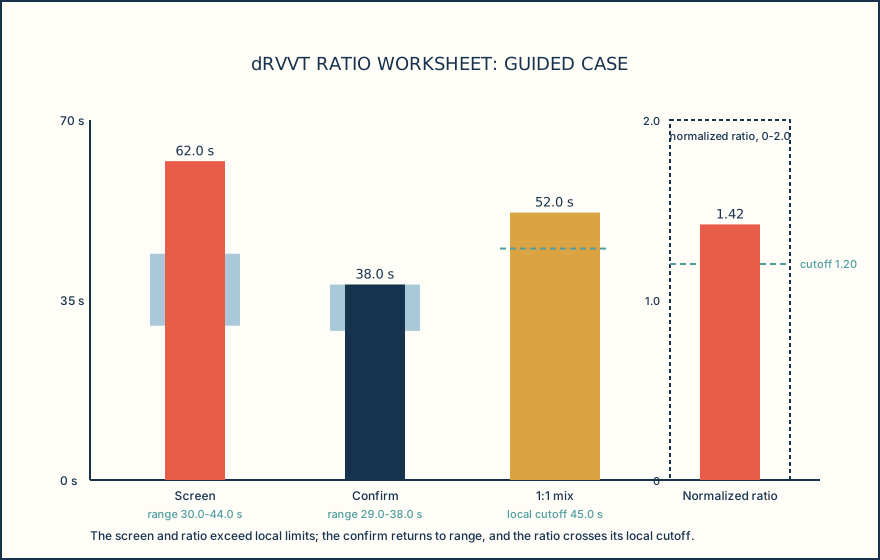
| Item | Result | Local context | Timing and flag |
|---|---|---|---|
| Specimen | 3.2% sodium-citrate platelet-poor plasma | residual platelet count below local limit | collected 09:10; no clot or hemolysis flag |
| PT | 11.8 s | 10.5-13.5 s | same specimen |
| aPTT routine | 48.2 s | 25.0-35.0 s | prolonged |
| dRVVT screen | 62.0 s | 30.0-44.0 s | prolonged |
| dRVVT confirm | 38.0 s | 29.0-38.0 s | screen shortens with high phospholipid |
| dRVVT normalized ratio | 1.42 | positive cutoff greater than 1.20 | abnormal, calculated |
| dRVVT 1:1 mix screen | 52.0 s | mix cutoff 45.0 s | no full correction |
| Silica normalized ratio | 1.28 | positive cutoff greater than 1.16 | abnormal, calculated |
Knowledge checks
Reading and checks are open. Sign in only to save.
Knowledge check 1
Knowledge check 2
Section status
Finish this section
Reading and checks are open. Sign in only to save.
The module finishes after every required section is marked done and every check in those sections is correct.