Required section · Section 2 of 6
Screen, mix, confirm: the three-gate logic
A laboratory LA evaluation uses two assay principles built on the same phospholipid-dependent logic. dRVVT activates factor X directly, downstream of the intrinsic pathway, using dilute Russell viper venom. A silica-based aPTT system instead measures a phospholipid-dependent intrinsic-pathway clotting time. The activator must be the one your laboratory has verified for sensitivity and local cutoffs; an ellagic-acid method is not interchangeable with the silica method. Because the two systems probe the clotting cascade differently, running both increases the chance of detecting an inhibitor that one system alone might miss.
Each system follows the same three-gate structure. Gate 1 is the screen: a reagent with low phospholipid concentration. If the screen is prolonged, the laboratory does not immediately call an inhibitor; it first checks for confounders, because anticoagulant effect, factor deficiency, and other coagulopathies can all prolong these assays. Gate 2 is the mix: a 1:1 mix with pooled normal plasma can help distinguish a factor deficiency, which corrects toward normal, from an inhibitor, which tends to resist correction. But dilution can make a weak LA appear corrected, so a corrected mix does not exclude LA on its own. Gate 3 is the confirm: a reagent with excess phospholipid is added, and a clotting time that shortens, or a screen-to-confirm ratio that crosses the local cutoff, supports phospholipid dependence, but only once confounders from Gate 1 are addressed.
ISTH guidance advises running the mix and the confirm step together on a prolonged screen rather than waiting for mix results before deciding whether to confirm. All of the numbers that come out of this workflow, raw clotting times, screen ratios, confirm ratios, and normalized ratios, are calculated outputs whose cutoffs are specific to the method, analyzer, reagent, and local reference population. None of the guided-case numbers here are a transferable reference interval.
No single gate stands alone. A screen tells you something is prolonged, a mix tells you whether dilution changes that, and a confirm tests whether the prolongation is phospholipid dependent.
Illustrative drawing — this picture was drawn rather than captured.
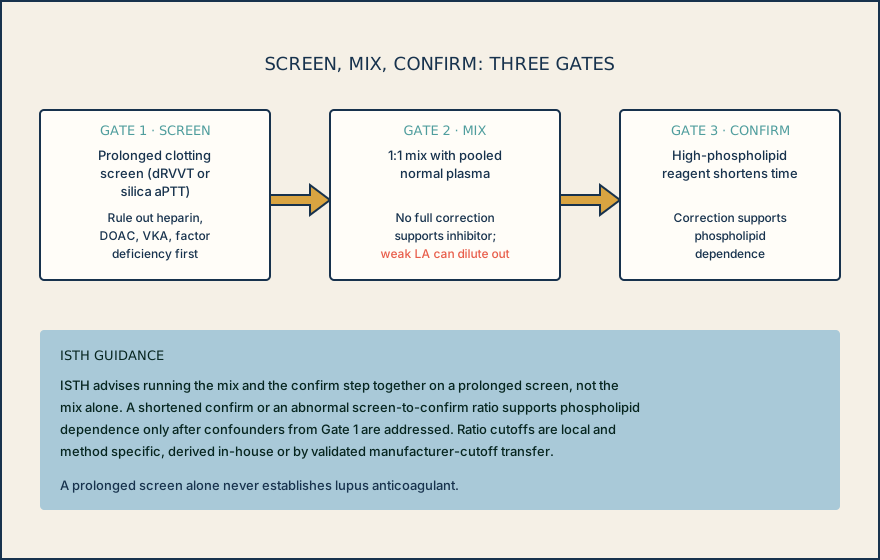
The screen, mix, confirm workflow applied to a prolonged LA screen.
Screen and rule out confounders
Run the low-phospholipid screen on both assay systems. Before proceeding, obtain routine coagulation background results and, when needed, anti-Xa or drug-specific testing to rule out heparin, DOAC, or vitamin K antagonist effect.
1:1 mix with pooled normal plasma
Run the mix alongside the confirm rather than waiting on it. Lack of correction supports an inhibitor, but correction does not exclude a weak LA because dilution can mask it.
High-phospholipid confirm and ratio
A shortened confirmatory clotting time or an abnormal locally validated screen-to-confirm ratio supports phospholipid dependence, once anticoagulant and other confounders have been addressed.
Integrate both systems and report
Combine dRVVT and silica aPTT findings, state any unresolved limitation, and choose a report category with the correct boundary language rather than a diagnostic claim.
Knowledge checks
Reading and checks are open. Sign in only to save.
Knowledge check 1
Knowledge check 2
Section status
Finish this section
Reading and checks are open. Sign in only to save.
The module finishes after every required section is marked done and every check in those sections is correct.