Required section · Section 5 of 6
Choose the report category
You now have the full picture for this specimen: two abnormal screens; two abnormal normalized screen-to-confirm ratios, dRVVT 1.42 and silica 1.28; a raw dRVVT confirm time within its own interval; an incompletely corrected mix; no known anticoagulant; an adequate specimen; and no acute-phase data. The decision in front of you is whether this testing is interpretable at all, whether the two assay systems can be integrated into one statement, and which report category with which limitation language best represents the evidence.
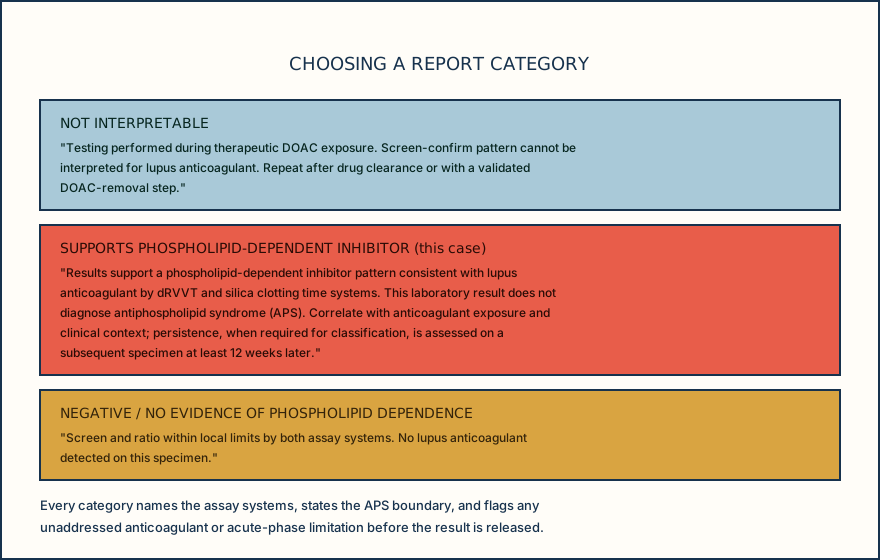
A report should identify the assay systems used, name any relevant anticoagulant or acute-phase limitation, and state plainly whether the observed pattern supports phospholipid dependence. It should never claim more than the testing shows. The 2023 ACR/EULAR APS classification criteria are classification criteria, not diagnostic criteria, and they define persistent LA as two positive tests at least 12 weeks apart; a single LA result may support a laboratory finding but cannot by itself establish persistence for APS classification.
Three report categories are available for a case like this: not interpretable, when a confounder such as active DOAC exposure has not been addressed; supports a phospholipid-dependent inhibitor pattern, when confounders are addressed and both systems show a concordant abnormal pattern; or negative, when the screen and ratio are within local limits by both systems. Choosing between them means weighing every gate result together, not anchoring on the single most abnormal number.
The words in the report do the diagnostic-boundary work, so the report category and its limitation language are as much a laboratory result as the ratio itself.
Illustrative drawing — this picture was drawn rather than captured.
Ordering exercise
Place these steps of the LA workup for the guided case in the order the laboratory actually performs them, from specimen receipt to report release.
1. Run dRVVT and silica aPTT screens
Perform the low-phospholipid screen on both assay systems.
2. Integrate findings and choose a report category
Weigh both assay systems and any unresolved confounder, then select not interpretable, supports phospholipid dependence, or negative, with the correct limitation language.
3. Review medication and specimen quality
Confirm platelet-poor plasma, no clot or hemolysis, and check for reported anticoagulant exposure before running the screen.
4. Calculate normalized ratios
Compute the screen-to-confirm normalized ratio for each assay system and compare to the local cutoff.
5. Run the 1:1 mix and the confirm together
On a prolonged screen, run the pooled-plasma mix and the high-phospholipid confirm in the same step rather than waiting on the mix result.
Knowledge checks
Reading and checks are open. Sign in only to save.
Knowledge check 1
Section status
Finish this section
Reading and checks are open. Sign in only to save.
The module finishes after every required section is marked done and every check in those sections is correct.