Required section · Section 3 of 6
Special handling that a cap color cannot tell you
The order of draw is the baseline. Many ordered tests add a requirement on top of it: a discard tube, a fill-volume adjustment, an exact clock time, or a temperature and light condition that starts the moment the needle enters the vein. None of these requirements can be read off a cap color; they come from the current test procedure for that specific analyte.
Citrate coagulation collection follows CLSI H21, the standard for plasma-based coagulation specimens. Whether a discard tube is required when citrate is first in a butterfly draw is a validated local procedure decision, and the discard blood itself is never used for testing. High hematocrit changes the plasma-to-citrate relationship because more of the tube's volume is occupied by cells rather than plasma; a cited trigger for evaluating an adjustment pathway is hematocrit above 55%, but the exact cutoff, formula, and who prepares an adjusted tube are set by the local validated coagulation procedure.
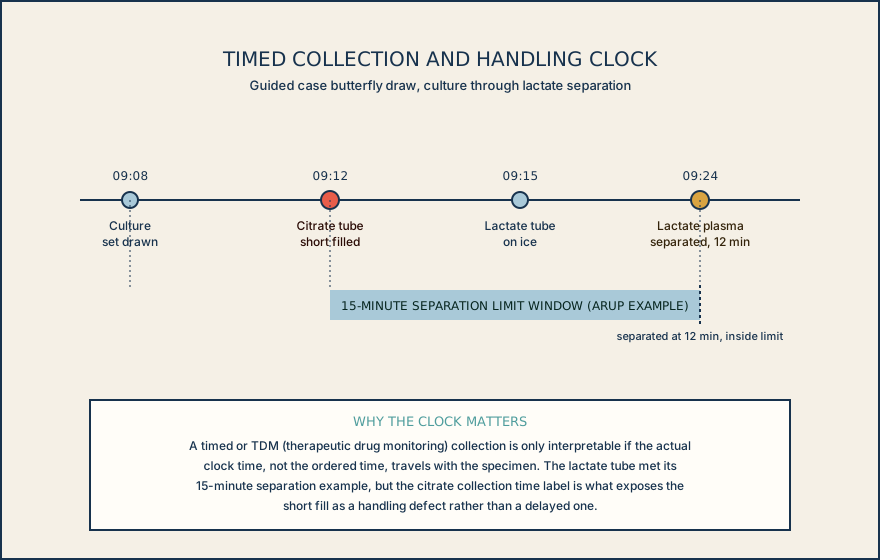
Timed collections, including therapeutic drug monitoring (TDM), endocrine panels, and glucose tolerance testing, depend on the actual collection clock time, not the ordered time. An oral glucose tolerance collection requires a fasting specimen before the glucose load, and every subsequent time point must be labeled with the time it was actually drawn. If a time point is missed, that is a documentation event, not a reason to estimate or silently adjust the label.
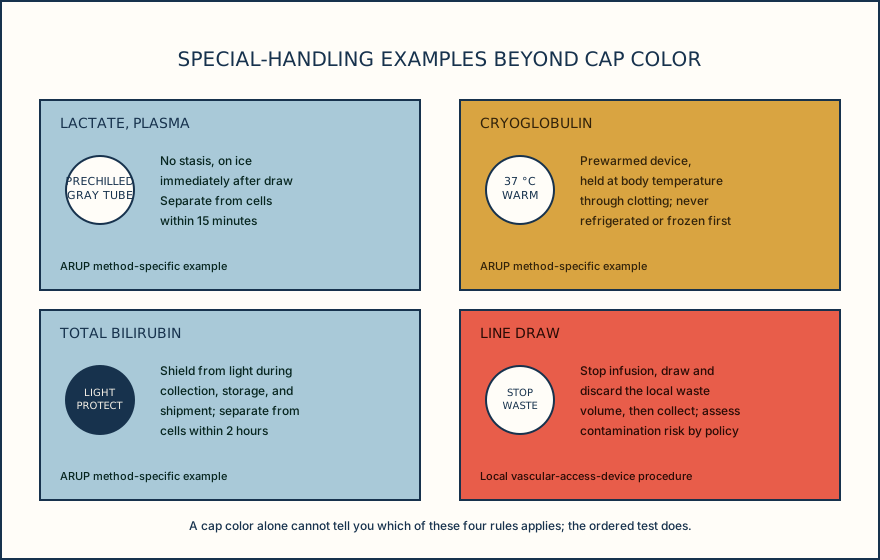
Some analytes need temperature or light control that starts at collection. A plasma lactate specimen in one manufacturer's method-specific instructions uses a prechilled gray tube, no stasis (limb compression) during draw, immediate ice, and separation from cells within 15 minutes. A cryoglobulin specimen in the same kind of instructions needs a prewarmed device held at 37 degrees Celsius through clotting, with no refrigeration or freezing before separation, the opposite handling from lactate. A total bilirubin specimen needs light protection from collection through shipment because bilirubin degrades under light exposure, with separation from cells within two hours. These controls prevent a time-, temperature-, or light-related specimen change that can produce an invalid result: lactate handling limits ongoing cellular metabolism, cryoglobulin warming avoids cold-related precipitation, line-draw stop/waste protects against line-fluid contamination, and bilirubin separation or light protection limits degradation.
Ammonia, trace element, blood bank, and molecular collections each carry their own dedicated-tube and handling requirements that cannot be inferred from general knowledge; take them from the current local procedure or the receiving laboratory's instructions. A line draw for any test adds its own layer: stop the infusion, draw and discard the locally defined waste volume, then collect, and document the contamination risk assessment under local policy before you decide whether recollection is required.
Before you draw or process anything unfamiliar, check whether that specific test requires a discard, a timed clock, a temperature or light condition, or a dedicated tube, because the tube's color will not tell you.
Illustrative drawing — this picture was drawn rather than captured.
Illustrative drawing — this picture was drawn rather than captured.
| Specimen | Temperature or light condition | Timing requirement | Source |
|---|---|---|---|
| Lactate, plasma | Prechilled tube, on ice immediately, no stasis | Separate from cells within 15 minutes | ARUP test-directory example |
| Cryoglobulin | Prewarmed device, held at 37 degrees C through clotting | No refrigeration or freezing before separation | ARUP test-directory example |
| Total bilirubin, serum or plasma | Protected from light throughout | Separate from cells within 2 hours | ARUP test-directory example |
| Citrate coagulation (high hematocrit) | Routine temperature; local adjustment procedure applies | Evaluate adjustment pathway above hematocrit 55%, cutoff set locally | Peer-reviewed review |
Knowledge checks
Reading and checks are open. Sign in only to save.
Knowledge check 1
Knowledge check 2
Section status
Finish this section
Reading and checks are open. Sign in only to save.
The module finishes after every required section is marked done and every check in those sections is correct.