Required section · Section 4 of 6
Working the gravimetric numbers
A chemistry bench is checking a P200 air-displacement pipette before preparing a dilution. The set volume is 100.0 microliters (uL). This is a pipette check, not a patient test; no patient specimen, reference range, analyzer result, reagent lot result, or critical value is involved. The same approved tip lot is used for every replicate, the tip is prewetted, aspiration is vertical, and each water delivery is weighed immediately after the reading stabilizes. Purified water and the balance have equilibrated at 22.0 degrees Celsius. The worksheet for this bench specifies a Z-factor of 1.0033 uL per milligram (mg), the conversion constant that turns weighed mass into calculated volume at this temperature.
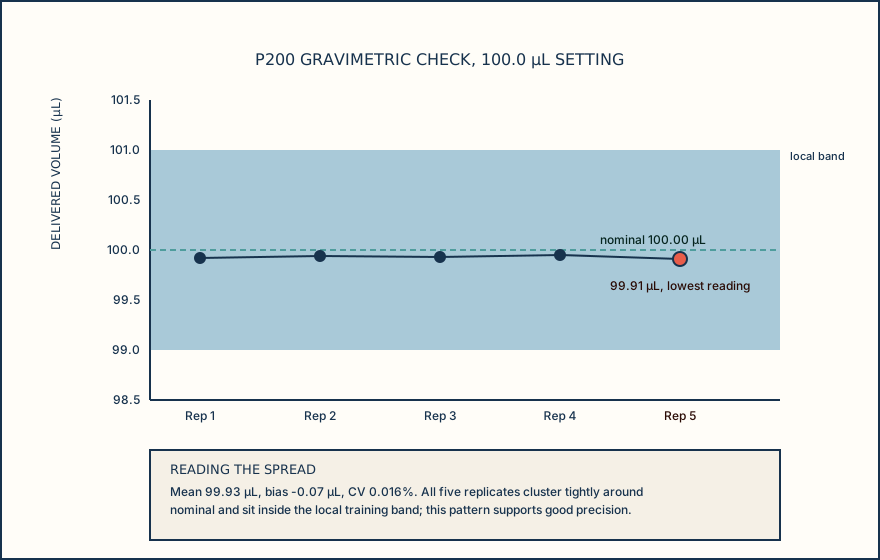
Five replicates were dispensed and weighed. Delivered volume for each replicate is net mass multiplied by the Z-factor. Replicate 1: 99.59 mg times 1.0033 equals 99.92 uL. The remaining four replicates follow the same calculation and are listed in the data table below with their calculated volumes.
Mean delivered volume across the five replicates is 99.93 uL. Bias, the systematic-error term, is mean delivered volume minus nominal volume: 99.93 minus 100.00 equals -0.07 uL, or -0.07 percent of the set volume. The replicate standard deviation (SD) is 0.016 uL, and the coefficient of variation (CV), the imprecision term, is 100 times SD divided by the mean: 100 times 0.016 divided by 99.93 equals 0.016 percent.
This bench's supplied local training criteria are an absolute mean bias no greater than 1.0 uL and a CV no greater than 0.50 percent at the 100.0 uL setting. This run's bias of -0.07 uL and CV of 0.016 percent both fall inside those criteria, so this check passes them. The narrow spread across replicates supports good precision for this run, and the mean sits slightly below nominal but within the supplied bias limit.
Passing this run does not prove the pipette performs acceptably at a different volume setting, with a different tip family, with a viscous or volatile liquid, or after the next scheduled maintenance interval. If a future run showed a mean consistently low with a similarly tight spread, the next step is to check technique, tip seal, and liquid conditions before concluding the pipette itself has drifted, since a tight offset cluster is the signature of systematic error whether the source is the operator, the tip, or the mechanism.
A passing gravimetric run tells you this pipette, at this setting, with this tip, met this run's criteria; it does not extend that judgment to any other setting, tip, or liquid.
Illustrative drawing — this picture was drawn rather than captured.
| Replicate | Net mass (mg) | Delivered volume (uL) | Flag |
|---|---|---|---|
| 1 | 99.59 | 99.92 | None |
| 2 | 99.61 | 99.94 | None |
| 3 | 99.60 | 99.93 | None |
| 4 | 99.62 | 99.95 | None |
| 5 | 99.58 | 99.91 | None |
Ordering exercise
Put the gravimetric verification workflow for the P200 pipette in the correct order, from balance setup through the pass or fail decision.
1. Compare against current criteria
Compare the calculated bias and CV against the current manufacturer specification, ISO 8655 requirement, and the laboratory's intended-use criteria to reach a pass or fail decision.
2. Dispense and weigh each replicate
Aspirate and dispense the set volume into the tared vessel, then record the stabilized net mass promptly for each replicate.
3. Equilibrate and tare
Bring purified water and the balance to the stated temperature, then tare the weighing vessel on the balance.
4. Calculate volume, bias, and CV
Convert each net mass to delivered volume with the Z-factor, then calculate the mean, bias, SD, and CV across replicates.
5. Prewet the tip
Prewet the tip with the test liquid per the SOP before the first measured replicate.
Knowledge checks
Reading and checks are open. Sign in only to save.
Knowledge check 1
Section status
Finish this section
Reading and checks are open. Sign in only to save.
The module finishes after every required section is marked done and every check in those sections is correct.