Required section · Section 5 of 6
Choose a technique, then read the pattern
You are setting up four transfers on the same bench: aqueous saline at room temperature, a volatile organic solvent, a viscous glycerol-based reagent, and a foaming protein-containing solution. For each liquid, decide whether standard forward pipetting with an air-displacement pipette is reasonable, or whether reverse pipetting or a positive-displacement pipette is the better-supported choice, using the liquid-behavior guidance from the focused-instruction section and your laboratory's SOP as the deciding authority.
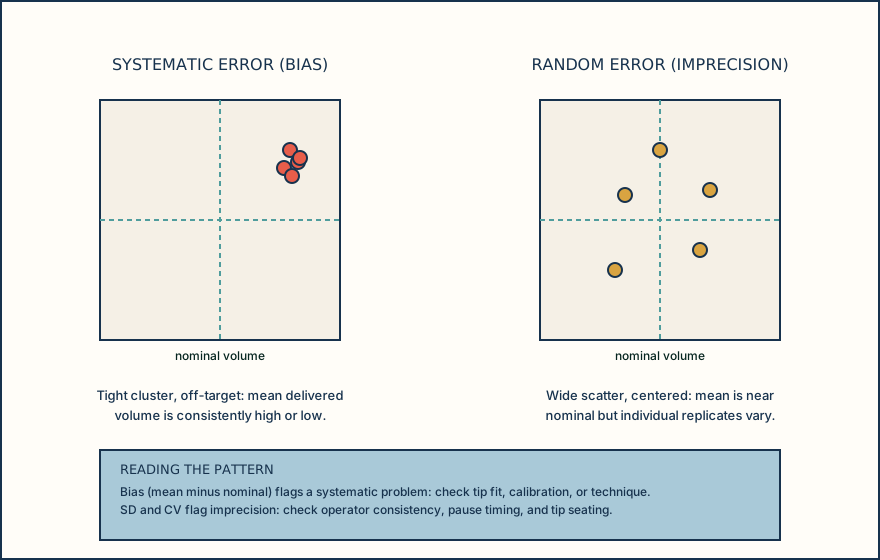
Next, you are handed two replicate sets from two other pipettes on the same bench, both tested at a 100.0 uL setting. Set A shows five replicates tightly clustered between 98.6 and 98.7 uL, all consistently below nominal. Set B shows five replicates ranging from 99.3 to 100.7 uL, scattered on both sides of nominal. Decide what each pattern most directly suggests before reading the feedback.
Finally, apply the supplied local training criteria, absolute mean bias no greater than 1.0 uL and CV no greater than 0.50 percent at 100.0 uL, to decide whether Set A and Set B pass or fail. This decision uses only the criteria supplied for this exercise, because no universal pass or fail threshold exists across pipettes, tips, and laboratories.
A pass or fail decision is only as good as the criteria behind it; state which criteria you used, not just the number you calculated.
Illustrative drawing — this picture was drawn rather than captured.
Illustrative drawing — this picture was drawn rather than captured.
| Set | Replicate range (uL) | Pattern |
|---|---|---|
| Set A | 98.6 to 98.7 | Tight cluster, consistently below nominal |
| Set B | 99.3 to 100.7 | Wide scatter, centered near nominal |
Knowledge checks
Reading and checks are open. Sign in only to save.
Knowledge check 1
Knowledge check 2
Knowledge check 3
Section status
Finish this section
Reading and checks are open. Sign in only to save.
The module finishes after every required section is marked done and every check in those sections is correct.