Required section · Section 4 of 6
Guided Case: A Cracked Safety Cup After Centrifugation
A technologist centrifuges six sputum specimens in sealed, aerosol-tight safety cups at 3,000 RPM for 15 minutes to concentrate a sample for AFB smear preparation, following an SOP that designates this step an aerosol-generating procedure. The risk assessment behind that SOP already assumes the specimen may contain Mycobacterium tuberculosis, an agent whose aerosol-generating manipulations are handled at BSL-3-level practices in many programs, even though routine smear microscopy on an unconcentrated primary specimen is often done at BSL-2. That distinction is procedure-specific, not organism-specific: the same specimen can move between BSL-2 and BSL-3-level handling depending on exactly what is being done to it.
After the rotor comes to a complete stop, the technologist opens the centrifuge lid and finds one safety cup with a hairline crack and a faint residue on its outside surface, consistent with a possible micro-leak during the run. Because a cracked cup with residue suggests a possible aerosol release inside the centrifuge bowl, the technologist does not reach in or open the cup further. The centrifuge stays closed, the unit is turned off and unplugged, and the area is posted out of service.
The technologist then waits at least 30 minutes, an interval consistent with published federal biosafety manual guidance for a suspected aerosol release, before reopening the bowl, to let any aerosol settle. Only after that wait does the sealed cup move to a certified BSC, where it is opened. This sequencing matters: opening a cup that may have leaked during the wait interval, or opening it on the open bench instead of inside a certified BSC, defeats the purpose of waiting in the first place.
Once the cup is opened inside the BSC and the specimen is secured, the contaminated centrifuge interior and any affected surfaces are decontaminated with a disinfectant effective against the anticipated organism, applied per label dilution and contact time, following the laboratory's written cleaning schedule and spill SOP. Any broken glass or sharps involved are collected with forceps, tongs, or a brush and dustpan; they are never picked up by hand. The timeline below lays out the case in minutes from the moment the rotor stopped.
A cracked cup after a run is a stop-and-wait event, not a look-and-decide event; the 30-minute settling interval and the move into a certified BSC come before the cup is reopened, not after.
Illustrative drawing — this picture was drawn rather than captured.
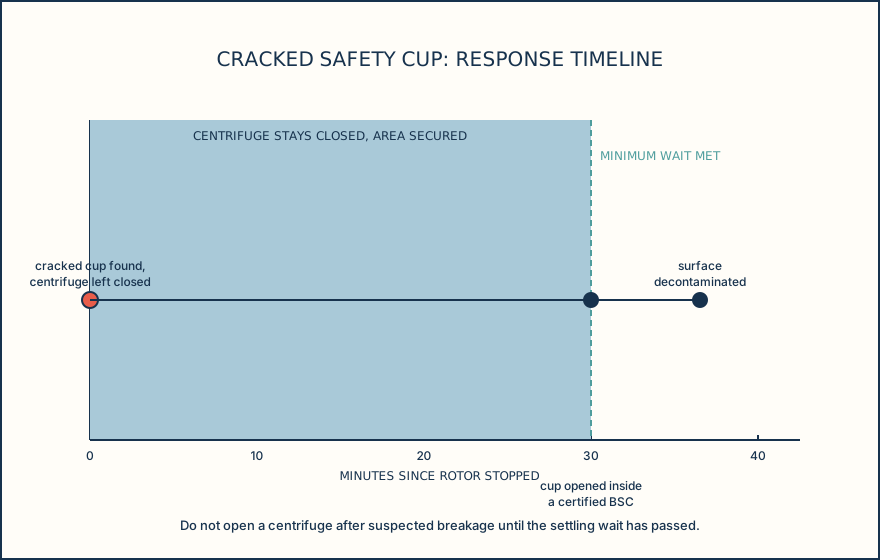
| Time (minutes) | Event | Action taken |
|---|---|---|
| 0 | Rotor stops, cracked cup with residue found | Centrifuge left closed, turned off, area posted out of service |
| 0 to 30 | Settling wait | Area secured, centrifuge not reopened |
| 30 | Wait interval complete | Sealed cup transferred to a certified BSC and opened there |
| 30 to 40 | Post-opening cleanup | Surfaces decontaminated per label and SOP; any sharps collected mechanically |
Knowledge checks
Reading and checks are open. Sign in only to save.
Knowledge check 1
Knowledge check 2
Section status
Finish this section
Reading and checks are open. Sign in only to save.
The module finishes after every required section is marked done and every check in those sections is correct.