Required section · Section 5 of 6
Set Up the Cabinet, Sequence the Response
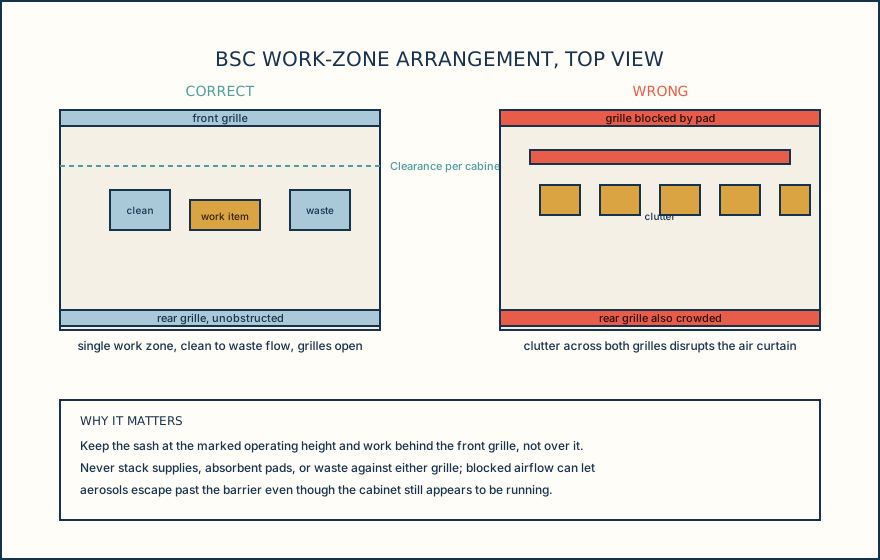
Two decisions face the technologist: keep the sash at its manufacturer-marked operating height, work behind the front grille, and keep front and rear grilles clear; and respond to breakage by stop, secure, wait, transfer sealed containment, then open. Clearance from the grille follows the cabinet marking, manufacturer instructions, and certification report.
The second decision is what to do the moment a centrifuge tube or safety cup shows signs of breakage. That decision has a defined order: stop and secure first, wait out the settling interval, move the sealed container into certified containment before opening it, and only then decontaminate. Reversing that order, for example opening the centrifuge immediately to inspect the damage, removes the protection the wait interval and the BSC transfer are there to provide.
Neither decision is a matter of memorizing one universal number. Sash height and grille clearance are set by the manufacturer's label and that cabinet's certification report; the routine (non-incident) settling time for centrifugation is set by institutional policy. What is fixed is the pattern: grilles stay clear, motion inside the cabinet stays slow and low, and a suspected aerosol release is met with stop, wait, transfer, then open.
When something breaks, the first correct action is almost always to do less, not more, keep the container sealed, keep the area closed, and let the certified containment device do the work of reopening it safely.
Illustrative drawing — this picture was drawn rather than captured.
Ordering exercise
The rotor has stopped and a safety cup shows a hairline crack with residue. Put the response steps in the correct order.
1. Decontaminate the surfaces
Apply an appropriate disinfectant per label dilution and contact time, per the written cleaning schedule.
2. Transfer the sealed cup into a certified BSC
Move the still-sealed safety cup into certified containment before it is opened.
3. Leave the centrifuge closed
Do not open the bowl further or reach in once a possible leak is visible.
4. Wait at least the settling interval
Hold at least 30 minutes, consistent with published federal biosafety manual guidance, before reopening.
5. Turn off the unit and secure the area
Power down or unplug the centrifuge and post the area out of service.
Knowledge checks
Reading and checks are open. Sign in only to save.
Knowledge check 1
Knowledge check 2
Section status
Finish this section
Reading and checks are open. Sign in only to save.
The module finishes after every required section is marked done and every check in those sections is correct.