Required section · Section 2 of 6
Personnel, Product, Environment: Three Protections, Not One
Every primary containment device can be described by which of three things it protects: the worker (personnel), the specimen or preparation (product), and the room or outside air (environment). A Class I BSC protects personnel and the environment through HEPA-filtered exhaust, but it draws unfiltered room air across the work surface, so it does not protect the product.
A Class II BSC is built to protect all three: inward airflow at the front grille protects the worker, HEPA-filtered downflow over the work surface protects the product, and HEPA-filtered exhaust protects the environment. A Class III BSC is a gas-tight, negative-pressure enclosure worked through glove ports, with supply air and double-HEPA (or HEPA plus incineration) exhaust; it gives the maximum personnel and environmental protection available and is reserved for the highest-risk work.
A laminar-flow clean bench inverts the Class II pattern: HEPA-filtered air still crosses the work surface, but it blows toward the operator, so it protects the product only. It provides no protection to the worker or the environment and must never be used for infectious, toxic, or otherwise hazardous material, no matter how convenient it is. HEPA filtration itself removes particulates and infectious aerosols, but it does not remove volatile chemical vapors or gases; that limit is why a BSC is never a substitute for a chemical fume hood when the hazard is a volatile chemical, and why a fume hood is never a substitute for a BSC when the hazard is infectious.
BSC class and biosafety level (BSL) answer different questions and are not interchangeable. Biological risk group, from the NIH Guidelines (RG1 through RG4), describes the hazard an agent poses to a healthy adult and whether treatment exists. Biosafety level, from the CDC/NIH Biosafety in Microbiological and Biomedical Laboratories (BMBL) manual (BSL-1 through BSL-4), describes the practices, personal protective equipment (PPE), primary containment, and facility controls applied to a specific activity. The same Class II BSC can be used across more than one BSL depending on a documented risk assessment; the cabinet class does not set the BSL by itself.
The diagram below traces the airflow path inside a Class II cabinet: inward air at the front grille, HEPA downflow at the work surface, and HEPA exhaust at the rear. Follow the path in order, because each stage protects a different party, and blocking any one stage removes that party's protection, not just a little airflow.
Before touching a specimen, ask which of the three protections you actually need, because a device sized for one is often useless, or dangerous, for another.
Illustrative drawing — this picture was drawn rather than captured.
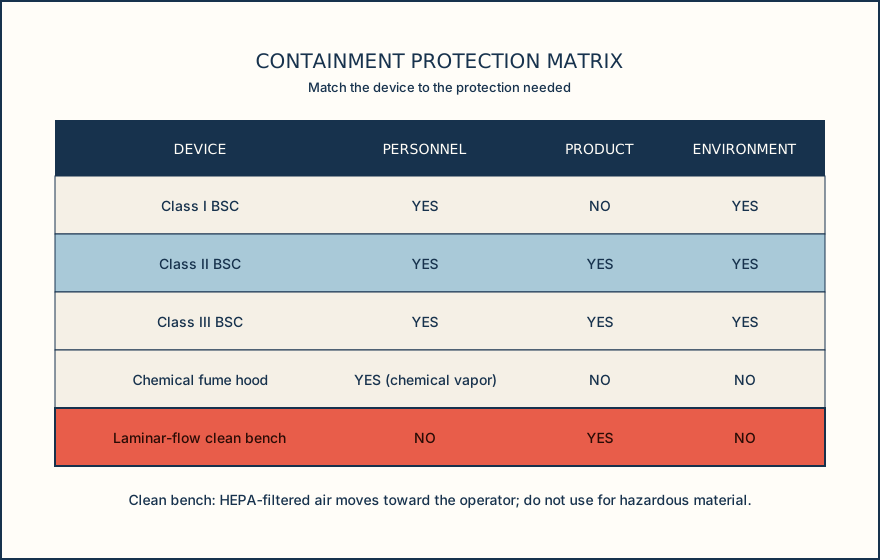
| Device | Airflow pattern | Protects |
|---|---|---|
| Class I BSC | unfiltered inflow, HEPA exhaust | personnel, environment |
| Class II BSC | HEPA inflow curtain, HEPA downflow, HEPA exhaust | personnel, product, environment |
| Class III BSC | gas-tight, glove-port, double-HEPA exhaust | personnel, product, environment (maximum) |
| Chemical fume hood | room air pulled past worker, exhausted | personnel (chemical vapor only) |
| Laminar-flow clean bench | HEPA air blown toward operator | product only |
Airflow path inside a Class II biosafety cabinet, from intake to exhaust.
Inward airflow at the front grille
Room air is drawn in at the front grille, forming an inward air curtain that keeps aerosols generated at the work surface from reaching the operator's breathing zone.
HEPA-filtered downflow
A supply HEPA filter delivers particulate-free air straight down over the work surface, protecting the specimen or preparation from contamination by room air or by the operator.
HEPA-filtered exhaust
Air converges at the rear grille and is exhausted through a HEPA filter before it returns to the room or is ducted outdoors, protecting the environment from anything aerosolized inside the cabinet.
Knowledge checks
Reading and checks are open. Sign in only to save.
Knowledge check 1
Knowledge check 2
Section status
Finish this section
Reading and checks are open. Sign in only to save.
The module finishes after every required section is marked done and every check in those sections is correct.