Required section · Section 3 of 6
Reading the label, the SDS, and the formaldehyde numbers
A compliant hazardous-chemical label carries six elements: product identifier, signal word, hazard statement(s), pictogram(s), precautionary statement(s), and the responsible party's name with a US address and US phone number. The signal word is either Danger for more severe hazards or Warning for less severe hazards; a label never carries both on the same container. OSHA requires eight possible pictograms -- flame, flame over circle, exploding bomb, gas cylinder, corrosion, skull and crossbones, health hazard, and exclamation mark -- each a black symbol on a white background inside a red diamond frame. A blank red diamond is never acceptable.
Precedence rules avoid redundant pictograms: if skull-and-crossbones covers acute toxicity, the exclamation mark is not also used for that same hazard, and if the corrosion pictogram applies, the exclamation mark is not used for skin or eye irritation from that same hazard.
Secondary containers -- the small bottles a technologist fills from a bulk carboy -- still need compliant labeling. A container of 100 mL or less may use minimum label information only when full labeling is not feasible, and a container of 3 mL or less may show only the product identifier only under the applicable conditions. Volume alone never permits reduced labeling; a 450 mL dispensing bottle needs its compliant label.
The SDS follows a fixed 16-section order, so route the task instead of reading it cover to cover. For a spill response, start at Section 6 for precautions, containment, cleanup, and drain guidance. For storage, use Section 7. For controls, PPE, and exposure limits, use Section 8. For incompatibility, use Section 10. For disposal, use Section 13 and then follow the approved federal, state, and local pathway. Section 4 supplies first aid and Section 11 describes health effects when either question is the decision in front of you.
If the needed SDS is missing, obsolete, or conflicts with the label, stop use or transfer and route the discrepancy to the designated owner or EHS under local procedure. If a dispensing bottle is unlabeled, do not guess at its contents or continue using it; stop the transfer, isolate it if needed, and use that same local route.
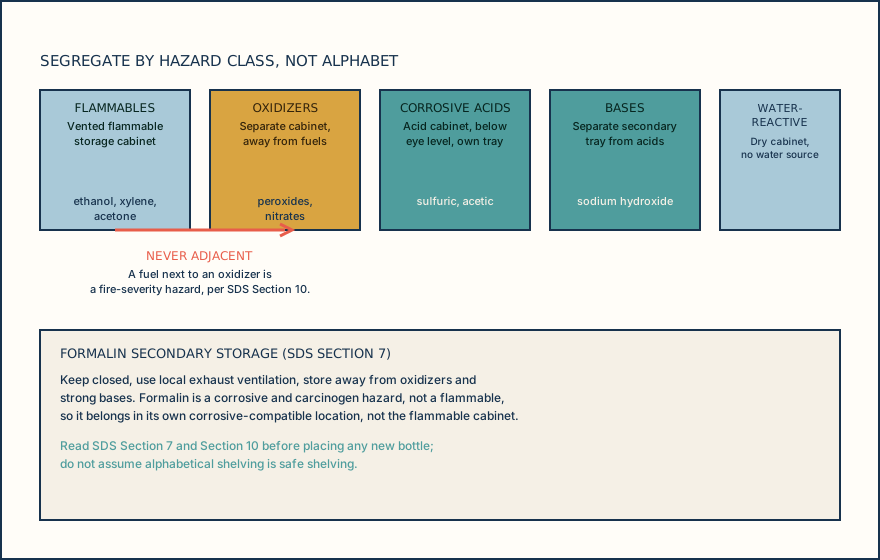
General chemical segregation keeps flammables, oxidizers, corrosive acids, bases, and water-reactive chemicals in separate storage groups, driven by hazard class from the SDS rather than alphabetical shelving. Storing bottles alphabetically without regard to hazard class is a recognized way incompatible chemicals end up next to each other -- an oxidizer beside a flammable is a fire-severity hazard, not a filing convenience.
Formaldehyde carries its own numeric exposure standard, 29 CFR 1910.1048: an action level of 0.5 ppm as an 8-hour TWA, a permissible exposure limit (PEL) of 0.75 ppm as an 8-hour TWA, and a short-term exposure limit (STEL) of 2 ppm over 15 minutes. Exposure monitoring is required at or above the action level or STEL; a result at or above 0.5 ppm TWA triggers repeat monitoring at least every 6 months, and a result at or above the 2 ppm STEL triggers repeat monitoring at least annually.
A posted, restricted-access regulated area is required only when airborne exposure exceeds the PEL or the STEL, not merely at the action level alone. Medical surveillance, including a baseline and annual exam, must be offered at no cost and without loss of pay to employees at or above the action level or STEL, and employees who must wear a respirator for formaldehyde control also require baseline and annual pulmonary function testing (FVC, FEV1, FEF).
Decode the label first for the hazard category, then route the decision to the SDS -- Section 6 for a spill, Section 7 for storage, Section 8 for controls and PPE, Section 10 for incompatibility, and Section 13 for disposal -- rather than reading the whole document top to bottom under time pressure.
Illustrative drawing — this picture was drawn rather than captured.
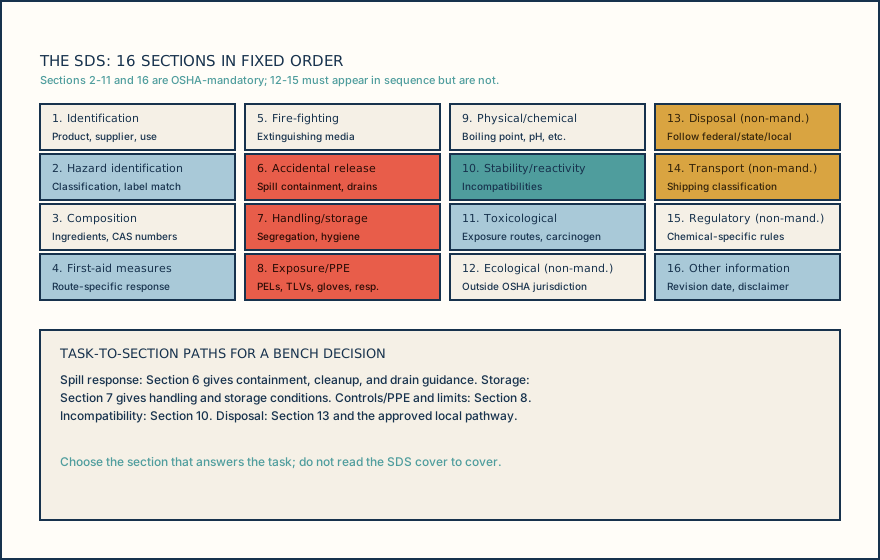
Illustrative drawing — this picture was drawn rather than captured.
| Task | SDS section | Use it to decide |
|---|---|---|
| Spill response | Section 6 | Personal precautions, containment, cleanup, and drain guidance |
| Storage | Section 7 | Safe handling and storage conditions |
| Controls, PPE, and limits | Section 8 | Exposure limits, engineering controls, and PPE |
| Incompatibility | Section 10 | Reactivity, stability, and incompatible materials |
| Disposal | Section 13 | Disposal considerations and the approved disposal pathway |
Knowledge checks
Reading and checks are open. Sign in only to save.
Knowledge check 1
Knowledge check 2
Knowledge check 3
Knowledge check 4
Section status
Finish this section
Reading and checks are open. Sign in only to save.
The module finishes after every required section is marked done and every check in those sections is correct.