Required section · Section 4 of 6
Guided example: reading this technologist's monitoring result
Return to the histology bench technologist decanting 10% neutral buffered formalin (about 3.7% formaldehyde). The label already establishes three hazard categories: carcinogenicity (health hazard pictogram, "may cause cancer"), corrosive skin and eye damage (corrosion pictogram), and acute irritation and sensitization (exclamation mark, "toxic if inhaled," "may cause an allergic skin reaction"). SDS Section 7 says to use local exhaust ventilation and store the container away from oxidizers and strong bases. SDS Section 8 lists the OSHA PEL of 0.75 ppm TWA and STEL of 2 ppm/15-min for formaldehyde and recommends nitrile or butyl-rubber gloves with chemical splash goggles.
The facility's full-shift personal air sample for this technologist reads 0.6 ppm formaldehyde as an 8-hour TWA, with a 15-minute STEL sample of 1.4 ppm during the transfer task. Compare each number to its own threshold rather than to a single combined limit: 0.6 ppm TWA is above the 0.5 ppm action level but below the 0.75 ppm PEL; 1.4 ppm STEL is below the 2 ppm STEL. Neither of the two thresholds that would trigger a mandatory posted regulated area (the PEL or the STEL) is exceeded by this result.
Because the TWA result is at or above the action level, two obligations follow regardless of the regulated-area question: periodic exposure monitoring repeats at least every 6 months while results stay at or above the action level, and medical surveillance must be offered to this technologist. PPE and engineering controls from SDS Sections 7 and 8 -- ventilation, gloves, eye protection -- apply because of the hazard classification itself, not only because of this specific number; they would still be required even at a lower reading.
During the same transfer, a small formalin drip (a few mL) lands on the bench. The trained technologist contains it immediately with the site's spill kit. Under HAZWOPER, 29 CFR 1910.120(a)(3), a release that employees in the immediate area can absorb, neutralize, or otherwise control at the time of release, without significant safety or health hazard, is an incidental release, handled by the local spill procedure rather than as an emergency response.
If instead the bulk carboy itself began leaking uncontrolled formalin with vapor spreading and the source could not be stopped, that pattern -- uncontrolled release, escalating vapor, source not stoppable -- points toward emergency response and evacuation rather than incidental cleanup. OSHA sets no fixed volume cutoff between the two; the determination depends on the chemical's hazard, quantity, whether the source can be stopped, ventilation, and whether trained staff can control it without significant exposure.
Read the TWA and STEL results against their own separate thresholds, not against each other, and let the regulated-area question (PEL or STEL exceedance) and the action-level obligations (monitoring, medical surveillance) be answered as two distinct checks on the same data.
Illustrative drawing — this picture was drawn rather than captured.
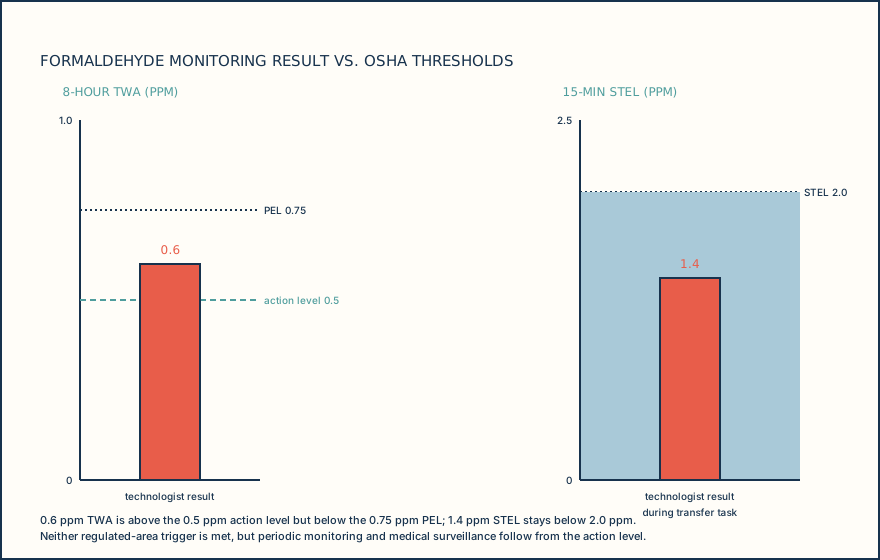
| Metric | Result | Threshold | Threshold met or exceeded |
|---|---|---|---|
| 8-hour TWA | 0.6 ppm | Action level 0.5 ppm | At or above action level |
| 8-hour TWA | 0.6 ppm | PEL 0.75 ppm | Below PEL |
| 15-min STEL | 1.4 ppm | STEL 2.0 ppm | Below STEL |
Knowledge checks
Reading and checks are open. Sign in only to save.
Knowledge check 1
Knowledge check 2
Section status
Finish this section
Reading and checks are open. Sign in only to save.
The module finishes after every required section is marked done and every check in those sections is correct.