Required section · Section 2 of 6
What pressure and extreme cold actually do
A compressed-gas cylinder stores its contents at high pressure in a fixed volume. If the valve, cap, or fitting is damaged, or if the cylinder is dropped, dragged by its valve, or otherwise stressed, that stored pressure can turn the cylinder itself into a projectile or release its contents suddenly. This is a mechanical hazard first, independent of whatever gas is inside; a cylinder of an inert gas is still a pressure hazard.
Cryogens add a second mechanism: extreme cold combined with a large liquid-to-gas expansion. Liquid nitrogen boils at about -196 degrees C (-321 degrees F); dry ice (solid carbon dioxide, CO2) sublimes directly from solid to gas at about -78 degrees C (-109 degrees F), skipping the liquid phase entirely. Either substance boiling or subliming in a closed or poorly ventilated room adds a large volume of gas to the air and displaces the oxygen already there.
Neither LN2 nor dry ice is toxic in the way a chemical fume is; the danger is that they can silently make a room's air unbreathable by displacement, and CO2 from dry ice can independently reach dangerous concentrations in an enclosed space even before the oxygen fraction alone would trigger a low-oxygen alarm, because CO2 is colorless, odorless, and heavier than air and can pool in low, poorly ventilated spaces.
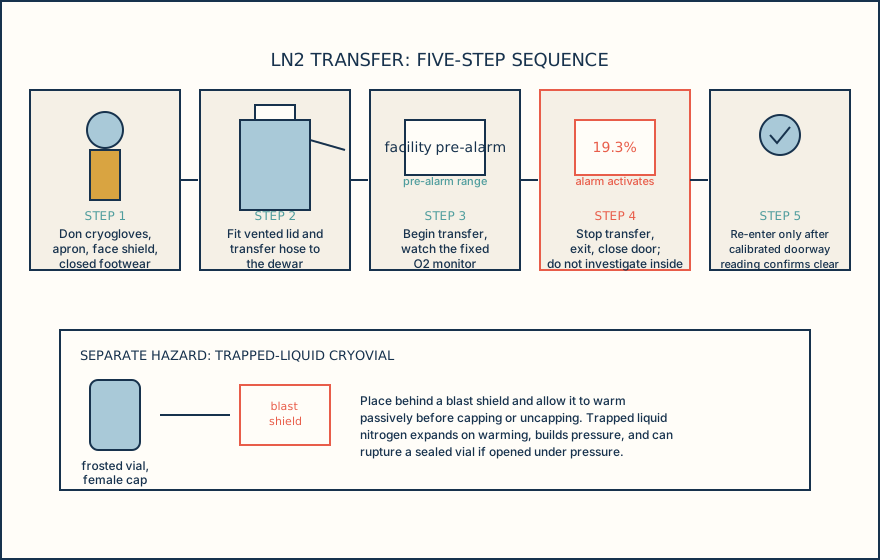
The same expansion that displaces room air can also rupture a sealed container. Liquid nitrogen trapped inside a sealed vial expands many times its liquid volume as it warms from liquid back to gas; if that expansion has nowhere to go, the container can fail explosively. Never store a cryogen, and never leave trapped cryogenic liquid, in a sealed airtight container above its boiling point.
OSHA defines an oxygen-deficient atmosphere as less than 19.5% oxygen by volume. That definition is not a facility alarm or pre-alarm setting. Monitor setpoints, alarm response, calibration status, and re-entry criteria come from the current approved site procedure. Before a cryogen transfer, confirm the required monitor is present, functioning, in date, and verified under that procedure; if it is missing, failed, overdue, unavailable, or unverified, do not proceed.
Treat both a pressurized cylinder and a boiling or subliming cryogen as sources of stored energy that fail without warning signs a person can feel, which is why physical securement and instrumentation, not judgment alone, are the controls that catch the failure.
Illustrative drawing — this picture was drawn rather than captured.
| Atmosphere condition | Oxygen by volume | Basis |
|---|---|---|
| Oxygen-deficient | Less than 19.5% | OSHA 29 CFR 1910.146, permit-required confined spaces |
| Normal room air | About 20.9% | Ambient baseline used in the guided case below |
| Oxygen-enriched | Greater than 23.5% | OSHA 29 CFR 1910.146, permit-required confined spaces |
| Substance | Phase-change point | Behavior |
|---|---|---|
| Liquid nitrogen (LN2) | -196 degrees C (-321 degrees F), boils | Trapped liquid expands greatly as it warms to gas; never seal it |
| Dry ice (solid CO2) | -78 degrees C (-109 degrees F), sublimes | Passes directly from solid to gas; CO2 can accumulate in low, unventilated spaces |
Routine LN2 top-off transfer, from protective equipment through confirmed re-entry after an alarm.
Don PPE
Put on loose-fitting cryogloves that can be shed quickly, an apron, a face shield, and closed footwear before opening the dewar.
Fit a vented lid and transfer path
Connect a vented lid and transfer hose to the dewar; never seal the receiving vessel or transfer path.
Transfer while watching the O2 monitor
Before transfer, verify the required room monitor is available, functioning, and current under the approved procedure; follow its facility alarm/pre-alarm response during transfer. If that verification cannot be made, do not start.
Stop and exit on alarm
If the audible low-oxygen alarm activates, stop the transfer immediately, exit without attempting to silence or investigate it from inside, and close the door.
Confirm before re-entry
Re-enter only as the current approved site procedure permits; do not rely on the wall display or a universal numeric setting.
Knowledge checks
Reading and checks are open. Sign in only to save.
Knowledge check 1
Knowledge check 2
Section status
Finish this section
Reading and checks are open. Sign in only to save.
The module finishes after every required section is marked done and every check in those sections is correct.