Required section · Section 4 of 6
Working the case: an alarm and a suspect vial
The setting is a core laboratory's specimen-receiving room, with a walk-in LN2 vapor-phase freezer bank (vials stored above the liquid) and a fixed oxygen monitor at the room entrance, plus a dry-ice receiving bay used twice a week for outside shipments. All times are on a 24-hour clock. At 07:52 the room O2 monitor reads a baseline 20.9%, normal room air, no alarm. At 08:04 a technologist begins a routine LN2 top-off of the freezer bank from a bulk dewar, using a vented lid, transfer hose, cryogloves, apron, and face shield per site procedure.
During the transfer, the monitor enters the facility’s pre-alarm range. That local setting and its required response come from the current approved procedure; it is not OSHA’s oxygen-deficiency definition and must not be inferred from it.
When the monitor alarm activates under the facility procedure, the technologist stops the transfer and exits without attempting to silence or investigate it from inside. The procedure, not a universal percentage, governs the alarm setting and response.
Mechanical exhaust continues with the door closed pending the procedure-required re-entry check. Re-entry is not based on a returned wall-display number alone; use the approved procedure and verified instrument check.
Separately, at 08:25, a cryovial pulled from the liquid phase of an older LN2 storage dewar for retrieval is visibly frosted and has a female-threaded cap. The technologist does not open it immediately. Following institutional guidance, it is placed behind a blast shield and allowed to warm passively before capping or uncapping, because trapped liquid nitrogen expanding many times its liquid volume on warming can rupture a sealed vial. A vial that was in the liquid phase, is frosted, and carries a female-threaded cap (a design more prone to trapping liquid than a male-threaded cap) is treated as a pressure hazard until it has equilibrated, not opened under time pressure.
At 09:40, at the receiving bay, an incoming shipment box marked "Dry ice, UN1845, net wt. dry ice 4.5 kg" and "Biological substance, Category B, UN3373" arrives. It is opened in a ventilated area, not in an enclosed vehicle cab or small closed room, because dry ice sublimating in an enclosed space is a documented CO2 asphyxiation risk independent of whatever the O2 monitor in that space happens to read.
The reasoning made visible across this case: the facility's alarm setting and response procedure, not a subjective sense of discomfort, trigger the response; a frosted, sealed vial that was in the liquid phase is a pressure hazard until it has passively equilibrated, regardless of how routine the retrieval feels; and a dry-ice shipment is a CO2 hazard in its own right, so ventilation and, where deployed, CO2 monitoring matter even in a space where an O2 monitor alone still reads normal. An O2 monitor answers whether the room is currently breathable, and a room CO2 measurement or adequate ventilation answers a related but separate question, so a normal O2 reading does not by itself clear a space for opening a fresh dry-ice shipment.
Illustrative drawing — this picture was drawn rather than captured.
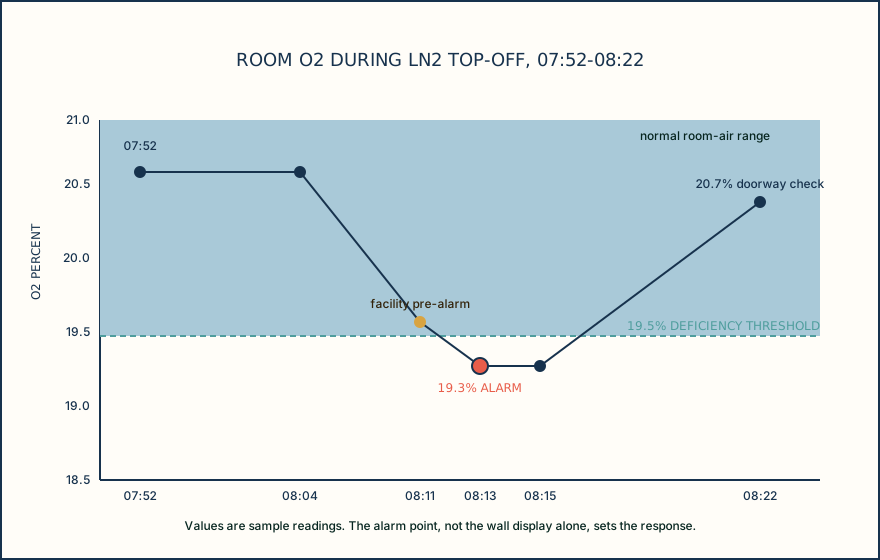
| Time | Room O2 | Event |
|---|---|---|
| 07:52 | 20.9% | Baseline reading, no alarm |
| 08:04 | 20.9% | LN2 top-off transfer begins |
| 08:11 | Facility pre-alarm setting | Follow approved procedure |
| 08:13 | Facility alarm setting | Stop transfer and exit per approved procedure |
| 08:22 | 20.7% | Doorway reading checked before re-entry |
Knowledge checks
Reading and checks are open. Sign in only to save.
Knowledge check 1
Knowledge check 2
Section status
Finish this section
Reading and checks are open. Sign in only to save.
The module finishes after every required section is marked done and every check in those sections is correct.