Required section · Section 3 of 6
Labels, securement, segregation, and PPE in detail
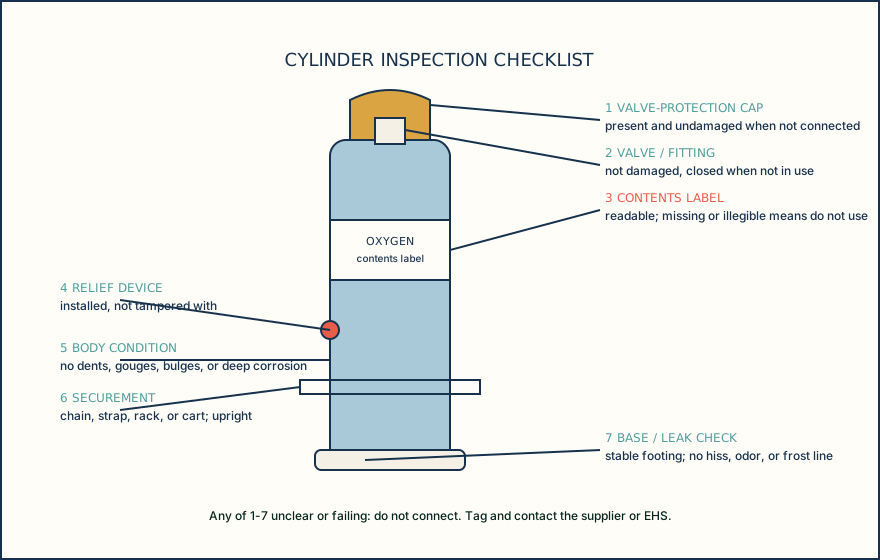
Read the label, not the color. Cylinder paint color is not a reliable identifier because color schemes vary by supplier; the product label is the primary identification method, with the outlet-connection fitting as a secondary check. If a label is missing, damaged, or illegible, do not use or connect the cylinder; contact the supplier instead of assuming contents from color, shape, or storage location.
The seven inspection points below (cap, valve, label, relief device, body condition, securement, and base/leak check) are the minimum visual check before any cylinder is connected or moved: dents, gouges, bulges, deep corrosion or rust, leaks, a damaged or missing valve-protection cap, a damaged valve, fitting, or relief device, and unreadable or missing content markings all mean the cylinder does not go into service until it is resolved. A cylinder with a supplier-resolvable defect is held out of service and routed to the supplier. A condition requiring quarantine or escalation is handled under the current procedure through EHS; do not decide that boundary from appearance alone.
Under OSHA's Hazard Communication standard (29 CFR 1910.1200, Appendix C), a compressed-gas cylinder's label carries a gas-cylinder pictogram with the signal word "Warning" for gases under pressure, and a refrigerated liquefied gas carries the same pictogram with a cryogenic-burn hazard statement; a cylinder can carry additional pictograms, such as flame, flame-over-circle, corrosion, or a health-hazard symbol, depending on its other properties.
Securement and movement follow the same logic as the label rule: do not trust judgment where a physical control exists. A cylinder must be kept upright and secured against falling, with a chain, strap, rack, cart, or equivalent restraint sufficient to prevent it from falling or becoming unstable. Move a cylinder only with a proper cylinder cart or hand truck, never dragged, rolled, or dropped, and never lift or move a cylinder by its valve or valve-protection cap. Close the valve before moving a cylinder, when it is empty, and when the job is finished, and keep the valve-protection cap in place whenever the cylinder is not connected for use. Never improvise a regulator or connection that was not designed for that cylinder and gas.
Oxidizers and fuel gases are segregated because a leak that would otherwise just be a pressure or asphyxiation hazard becomes an ignition hazard once both are present together. Under OSHA 1910.253(b)(4)(iii), oxygen cylinders in storage must be separated from fuel-gas cylinders or combustible material by at least 20 feet, or by a noncombustible barrier at least 5 feet high with a minimum half-hour fire-resistance rating. This is a storage-area design requirement, not a suggestion to keep cylinders generally apart; the exact room layout, cabinet use, and signage for a given site are local decisions built around that minimum.
Dry ice and LN2 require a local quantity and ventilation assessment before use. No universal room or vehicle quantity makes use safe: the planned amount, enclosure, ventilation, and approved procedure control the decision.
Never handle either with bare hands; use cryogenic gloves designed to be loose-fitting, so they can be shed quickly if liquid nitrogen splashes in or dry ice falls inside, plus eye protection, and never store either in a sealed, airtight container above its boiling point, since the resulting gas pressure can cause an explosion.
Carbon dioxide from dry ice carries its own numeric exposure limits, separate from the oxygen-deficiency threshold, because a room or vehicle can accumulate CO2 to a hazardous level while the O2 percentage alone still looks close to normal. Storage and use of compressed gases and cryogenic fluids outside a laboratory work area (bulk or central supply) falls under NFPA 55, while storage and use inside the laboratory work area itself falls under the separate NFPA 45 laboratory chemical fire-protection code; which code governs a given room is a scope question worth confirming locally rather than assuming.
Label, cart, valve closed, cap on, upright and secured, ventilated space, vented lid, and never sealed are not six separate rules to memorize individually; they are the same principle (do not let stored pressure or displaced oxygen surprise you) applied to a cylinder, a dewar, and a shipping box in turn.
Illustrative drawing — this picture was drawn rather than captured.
| Limit | Value | Basis |
|---|---|---|
| OSHA permissible exposure limit (PEL) | 5,000 ppm, 8-hour time-weighted average (TWA) | OSHA chemical sampling reference, carbon dioxide |
| NIOSH recommended exposure limit (REL) | 5,000 ppm TWA / 30,000 ppm short-term (STEL) | OSHA chemical sampling reference, carbon dioxide |
| Immediately dangerous to life or health (IDLH) | 40,000 ppm | OSHA chemical sampling reference, carbon dioxide |
Knowledge checks
Reading and checks are open. Sign in only to save.
Knowledge check 1
Knowledge check 2
Knowledge check 3
Section status
Finish this section
Reading and checks are open. Sign in only to save.
The module finishes after every required section is marked done and every check in those sections is correct.