Required section · Section 5 of 6
Choose the next evidence
A result must be released with what the method supports and with its uncertainty. For the guided case, select the action that preserves the HPLC observation, adds the relevant CBC context, and avoids a genotype claim that the method cannot establish. The needed follow-up depends on the local reflex criteria, the exact analyzer and reagent configuration, and whether the question remains clinically consequential.
For an HPLC fraction that may share a retention window, inspect the exact chromatogram and compare its retention time with the current analyzer, reagent, and software instructions. If the HPLC limitation remains, perform the locally validated CE follow-up; refer for targeted molecular testing only when the remaining question is a defined globin-gene sequence or copy-number change and the referral assay covers it.
When the pattern is unresolved, document the method, the competing explanation, and the local-policy follow-up rather than forcing a final identity.
Illustrative drawing — this picture was drawn rather than captured.
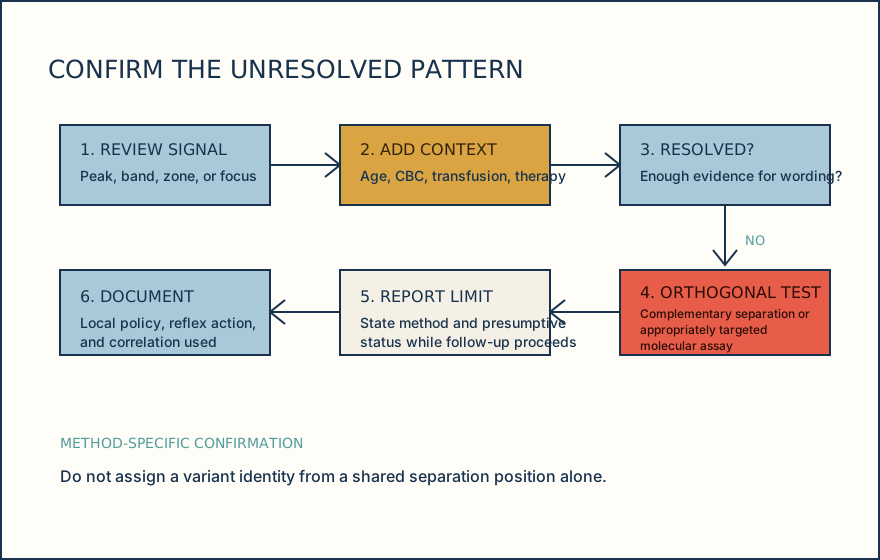
Ordering exercise
Put the review steps in the order that avoids assigning an unsupported identity.
1. Select orthogonal evidence
Choose a complementary separation or molecular method that addresses the unresolved possibility.
2. Report bounded conclusion
State the method and presumptive status, then follow local policy.
3. Review context
Check age, CBC indices, and transfusion, transplant, or therapy history.
4. Review the analytical signal
Identify what the declared method actually measured.
Knowledge checks
Reading and checks are open. Sign in only to save.
Knowledge check 1
Section status
Finish this section
Reading and checks are open. Sign in only to save.
The module finishes after every required section is marked done and every check in those sections is correct.