Required section · Section 2 of 6
Basic mental model
Thalassemia patterns arise when alpha or beta globin-chain production is reduced or absent. Hemoglobin assembly requires a balanced supply of chains. The laboratory pattern therefore reflects chain imbalance, developmental stage, and the amount of residual chain production. One index or one fraction cannot describe all of that biology.
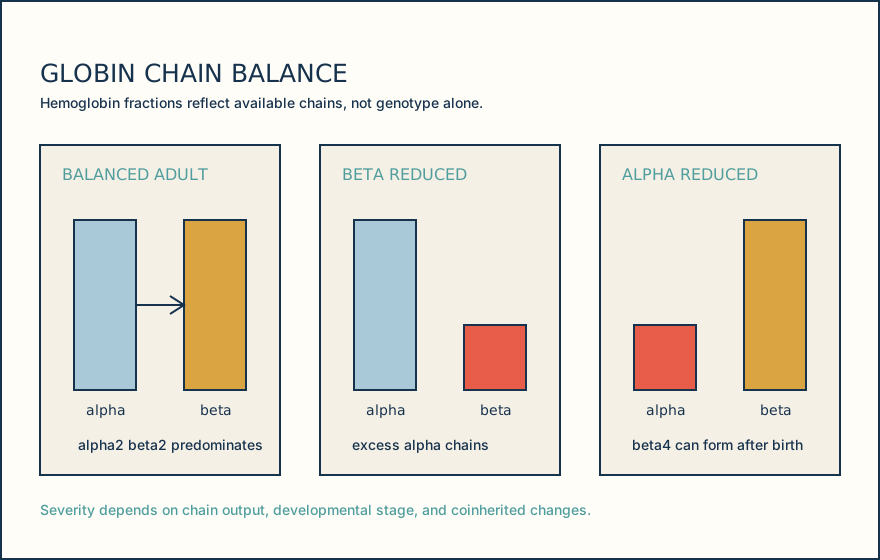
Reduced beta-chain production leaves relatively excess alpha chains and can produce beta-thalassemia carrier, intermedia-pattern, or major-pattern findings. Severity and presentation vary across genotypes, so those pattern labels are descriptive rather than molecular calls. More severe beta patterns can show greater anemia, anisopoikilocytosis, and nucleated red blood cells. Erythroblast number relates to anemia severity in the cited data.
Reduced alpha-chain production has a different timing problem. In fetal life, marked alpha deficiency can permit gamma4 tetramers called Hb Bart. After the fetal-to-adult switch, beta4 tetramers called HbH can be detectable in HbH disease. Alpha-thalassemia trait may instead produce microcytosis with adult hemoglobin analysis that is not diagnostic.
Start by naming the observable pattern, not by guessing a genotype from a percentage. Read the smear and indices with the fractionation result, age, and history. Chain balance is the reusable model that explains why alpha and beta patterns do not look identical.
Illustrative drawing — this picture was drawn rather than captured.
Build a thalassemia pattern from linked evidence rather than a single result.
Review CBC and smear
Identify anemia severity, microcytosis, RBC count pattern, and morphology.
Establish context
Confirm age, iron status, transfusion history, and specimen or method information.
Interpret fractions
Read HbA2, HbF, HbH, or Hb Bart in the correct developmental and analytical context.
Choose bounded correlation
Use a second method, molecular testing, or family correlation when the pattern remains unresolved or clinically important.
Knowledge checks
Reading and checks are open. Sign in only to save.
Knowledge check 1
Section status
Finish this section
Reading and checks are open. Sign in only to save.
The module finishes after every required section is marked done and every check in those sections is correct.