Required section · Section 2 of 6
What concentrates the sediment
Formed elements, cells, casts, crystals, and organisms, are diluted through the whole volume of urine as it is voided. Sediment examination exists to concentrate that dilute suspension into a small, examinable deposit. The concentration factor is not a fixed number; it is the product of the aliquot taken, the centrifugal force and time applied, how much supernatant is removed, and how the remaining deposit is resuspended and loaded for viewing.
Change any one of those variables and the recovered elements change with it. A published preanalytical study varying relative centrifugal force, tube type, aliquot volume, and supernatant removal technique found that each of those choices measurably shifted what was recovered in the deposit. That is exactly why a laboratory's centrifugation conditions, residual volume, and report units are validated local method values, not a universal lesson recipe: the same specimen examined by two different valid protocols can legitimately report different counts.
Time, temperature, and preservation alter what can be recovered and identified, so record them as specimen conditions rather than treating transport as a generic compliance issue. During an ambient-temperature delay, erythrocytes and leukocytes can lyse or lose recognizable morphology; alkaline, dilute urine can dissolve hyaline and other fragile casts; bacteria can multiply while protozoal motility declines; and bacterial pH change can dissolve existing crystals or precipitate new ones. Refrigeration slows cell lysis and bacterial multiplication but can promote crystal precipitation, so a refrigerated specimen may preserve cells while showing crystals not seen at voiding. A preservative may stabilize cellular morphology and suppress bacterial growth, but can also reduce organism motility or alter crystal appearance; it does not recreate the specimen at collection. Interpret delayed, refrigerated, or preserved sediment with those element-specific effects in mind.
Mix the received specimen thoroughly before the aliquot is taken, because formed elements settle and an aliquot from an unmixed specimen samples an unrepresentative layer. After centrifugation, decant or aspirate the supernatant to the residual volume the method specifies, then resuspend gently. Vigorous mixing can disrupt fragile casts; too little mixing leaves the deposit unevenly distributed on the slide or in the chamber.
If you cannot state the aliquot, the force and time, and the residual volume your laboratory uses, you cannot defend the count that follows from them.
Illustrative drawing — this picture was drawn rather than captured.
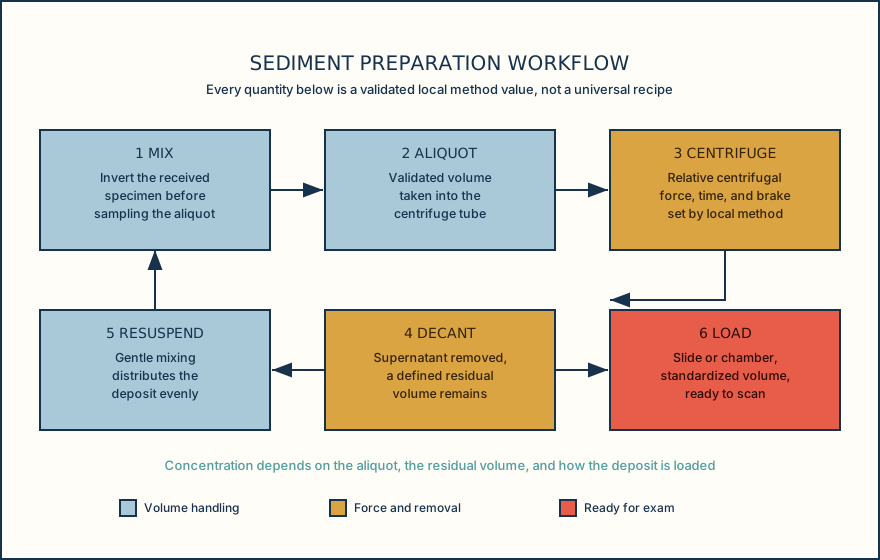
Preparation workflow that determines how representative and how concentrated the examined deposit is.
Mix
Invert the received specimen to resuspend settled elements before the aliquot is taken.
Aliquot
Measure the validated volume into the centrifuge tube; the volume taken sets the starting concentration.
Centrifuge
Apply the validated relative centrifugal force, time, and brake setting; these change what is recovered in the deposit.
Decant
Remove supernatant to the validated residual volume by decanting or aspiration; the technique affects deposit consistency.
Resuspend
Mix the residual deposit gently so formed elements distribute evenly without disrupting fragile casts.
Load
Transfer a standardized volume to a slide or counting chamber, ready for the fixed scanning sequence.
Knowledge checks
Reading and checks are open. Sign in only to save.
Knowledge check 1
Section status
Finish this section
Reading and checks are open. Sign in only to save.
The module finishes after every required section is marked done and every check in those sections is correct.