Required section · Section 3 of 6
Methods, look-alikes, and confirmation
Agarose gel electrophoresis produces stained bands read by densitometry. Capillary zone electrophoresis (CZE) produces a UV-absorbance electropherogram in a liquid-filled capillary. Both separate the five major fractions, but CZE often resolves beta into beta-1 and beta-2, so values are not numerically interchangeable.
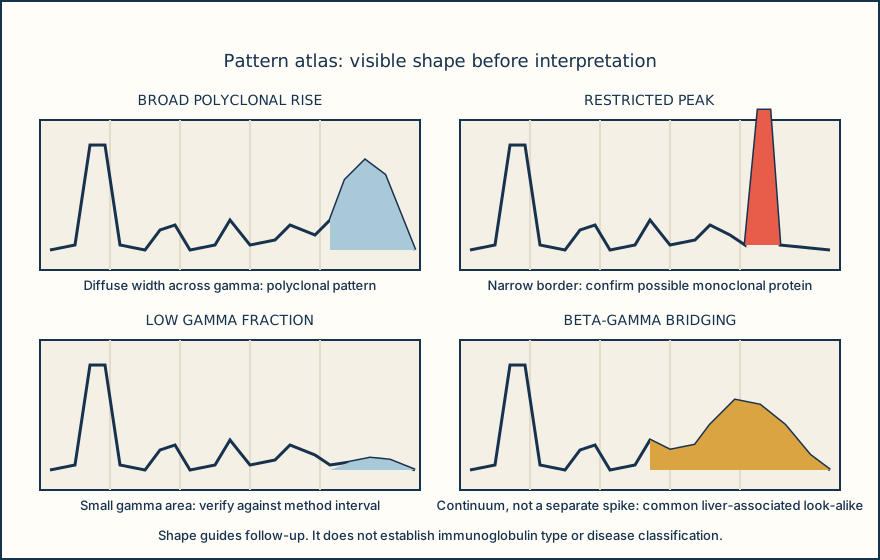
A restricted feature on SPEP is not immunotyping. Immunofixation electrophoresis (IFE) uses heavy-chain and light-chain antisera to identify an immunoglobulin class and kappa or lambda type. Serum free light chain (sFLC) testing and the kappa/lambda ratio complement SPEP and serum IFE because a negative SPEP does not exclude a small, oligosecretory, or light-chain-only presentation.
Check look-alikes before treating a peak as biologic. In incompletely clotted plasma, residual fibrinogen can migrate in the fast-gamma or beta-gamma region. Hemolysis releases hemoglobin, which forms a hemoglobin-haptoglobin complex in the alpha-2 region. Recent iodinated contrast can create a UV-detected CZE feature near beta. An unexplained peak starts with specimen type, integrity, and interference review, not a disease label.
Illustrative drawing — this picture was drawn rather than captured.
Knowledge checks
Reading and checks are open. Sign in only to save.
Knowledge check 1
Knowledge check 2
Section status
Finish this section
Reading and checks are open. Sign in only to save.
The module finishes after every required section is marked done and every check in those sections is correct.