Required section · Section 5 of 6
Choose follow-up for restricted patterns and urine findings
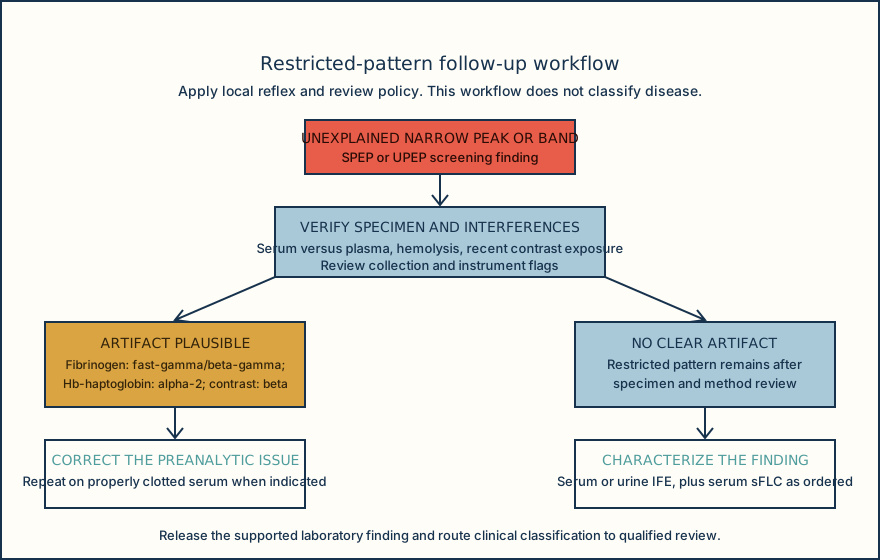
A narrow beta-gamma band on a specimen submitted as plasma is not ready for monoclonal interpretation. Incomplete clotting leaves fibrinogen that can migrate in the fast-gamma or beta-gamma region. Verify specimen type and repeat on properly clotted serum before treating the finding as a true band.
For a restricted serum pattern that remains after review, serum IFE and sFLC are complementary studies in the suspected monoclonal gammopathy workup. A normal SPEP does not rule out a plasma-cell disorder, so the choice is not to rely on SPEP alone. Local protocol sets reflex triggers and review ownership.
UPEP has a separate concentration question. Total urine protein excretion is expressed as mg/24 h or g/24 h, while a spot concentration depends on urine dilution. A discrete urine beta or gamma band needs urine IFE for confirmation and typing. Choose follow-up from specimen, pattern, and method evidence, then use the local policy card for thresholds.
Illustrative drawing — this picture was drawn rather than captured.
Ordering exercise
Put the laboratory actions in the preferred sequence when a narrow beta-gamma feature appears on a specimen submitted as plasma.
1. Perform indicated characterization
Use IFE and complementary testing according to local protocol if a restricted feature remains.
2. Repeat electrophoresis
Determine whether the feature persists on the corrected specimen.
3. Review specimen type and integrity
Confirm plasma versus serum and assess hemolysis or interference clues.
4. Obtain properly clotted serum
Correct incomplete-clotting fibrinogen that can migrate in the fast-gamma or beta-gamma region before interpreting a band.
Knowledge checks
Reading and checks are open. Sign in only to save.
Knowledge check 1
Knowledge check 2
Section status
Finish this section
Reading and checks are open. Sign in only to save.
The module finishes after every required section is marked done and every check in those sections is correct.