A water-bath display of 37 °C, a pipette setting of 100 µL, and the etched line on a volumetric flask are nominal values. The laboratory selects equipment that meets the measurement procedure's requirements, then verifies what each item contains, delivers, weighs, heats, cools, or separates under its conditions of use.
Temperature-controlled equipment
Reaction rates, enzyme stability, incubation, and chromatography all depend on temperature. Check water baths, heating blocks, incubators, refrigerators, freezers, and instrument compartments at the temperatures the procedure uses. A display reading does not establish the temperature at the sample position, so measure the temperature where the sample sits.1
Convert between the two scales whenever an instrument display and the procedure use different units: °C = (°F − 32) × 5/9, and °F = (°C × 9/5) + 32.
Scroll sideways to see all columns
| Sensor | Measurement principle | Useful feature | Important check |
|---|---|---|---|
| Organic-liquid-in-glass thermometer | Thermal expansion moves a liquid column along a scale | Simple local indication | Inspect for a separated column, bubbles, scale damage, correct immersion depth, and parallax |
| Thermistor (NTC type) | A metal-oxide semiconductor element; in the negative-temperature-coefficient type described here, resistance falls sharply as temperature rises | High sensitivity over a limited range; small probe, used inside instruments such as freezing-point osmometers | Use the correct probe, readout, and calibration equation as one matched set |
| Thermocouple | A junction between dissimilar metals produces a temperature-dependent voltage | Fast response and a broad working range | Match thermocouple type, extension wire, and cold-junction compensation |
| Platinum resistance thermometer | Platinum resistance changes reproducibly with temperature | Stability suited to reference measurements | Apply the calibration correction for the probe and readout together |
Metrological traceability is a property of a measurement result. It requires a documented, unbroken chain of calibrations to a specified reference, with every link contributing to the measurement uncertainty. A "NIST traceable" label does not establish traceability. The calibration records establish the chain and identify the reference device, calibration results and uncertainty, calibration points, correction factors, and the device being checked.2
For a 37 °C bath, allow the bath and the reference probe to equilibrate, measure at the working setpoint and at representative sample locations, apply the reference correction, and compare the result with the acceptance interval in the measurement procedure. Map locations when uniformity matters. Set check and recalibration intervals from manufacturer instructions, stability history, use, and the consequence of an out-of-range temperature. One year is a common starting interval. Change it when observed drift justifies a change.1
Keep baths and blocks free of scale and residue, and seat probes in full contact with the measured medium, so buildup or poor contact cannot bias the reading.1
Mercury thermometers are leaving laboratory service because mercury is a potent neurotoxin. NIST stopped calibrating mercury thermometers on March 1, 2011, and recommends calibrated nonmercury alternatives: platinum resistance thermometers, thermistors, thermocouples, and organic-liquid-in-glass devices.3 Dispose of any mercury thermometer found in older supplies through the laboratory's chemical-waste program.
Volumetric glassware and pipettes
Function and class
Volumetric apparatus is manufactured to a stated tolerance at a stated calibration temperature. To contain (TC) ware holds its stated volume, and residual liquid remains after pouring. To deliver (TD) ware releases its stated volume when the specified drainage procedure is followed. ASTM E694 gives the general requirements for Class A and Class B laboratory glass volumetric apparatus. Class B tolerances are commonly twice the corresponding Class A tolerance, and the specific apparatus specification states any exception.4
Scroll sideways to see all columns
| Vessel | Intended use | Reading point |
|---|---|---|
| Volumetric flask | One exact final volume | Add solvent to the single calibration line |
| Graduated cylinder | Approximate volumes | Read the graduation at the bottom of the meniscus |
| Beaker or Erlenmeyer flask | Mixing, heating, holding | Side markings are estimates |
Scroll sideways to see all columns
| Pipette | Delivers | Technique |
|---|---|---|
| Volumetric (transfer) | One fixed volume | Self-draining by the marked TD procedure; bulb in the stem |
| Ostwald-Folin | One fixed volume of a viscous biologic fluid | Use a mechanical controller; blow out only as its marking and procedure require; two etched rings near the mouthpiece |
| Mohr (measuring) | A measured interval between graduations | Self-draining; graduations stop above the tip |
| Serologic (measuring) | Variable volumes through the tip | Use a mechanical controller; follow the marked drainage rule; graduations continue to the tip |
| Pasteur and other disposable transfer | Approximate transfer | Too imprecise for measured volumes |
For clear aqueous liquids, read the bottom of the meniscus (the curved upper surface of the liquid) at eye level unless the device or procedure specifies another convention. Current routine microliter work uses a calibrated air-displacement or positive-displacement pipette with its matched tip. Graduated glass or plastic pipettes remain appropriate when a validated method requires them, and they must be operated with a mechanical controller. Mouth pipetting is prohibited.5 A blowout pipette carries a continuous etched band or double ring and requires expelling its residual liquid. A self-draining pipette completes delivery by gravity after the stated drainage time. Applying one pipette's drainage rule to every design creates a systematic volume error.
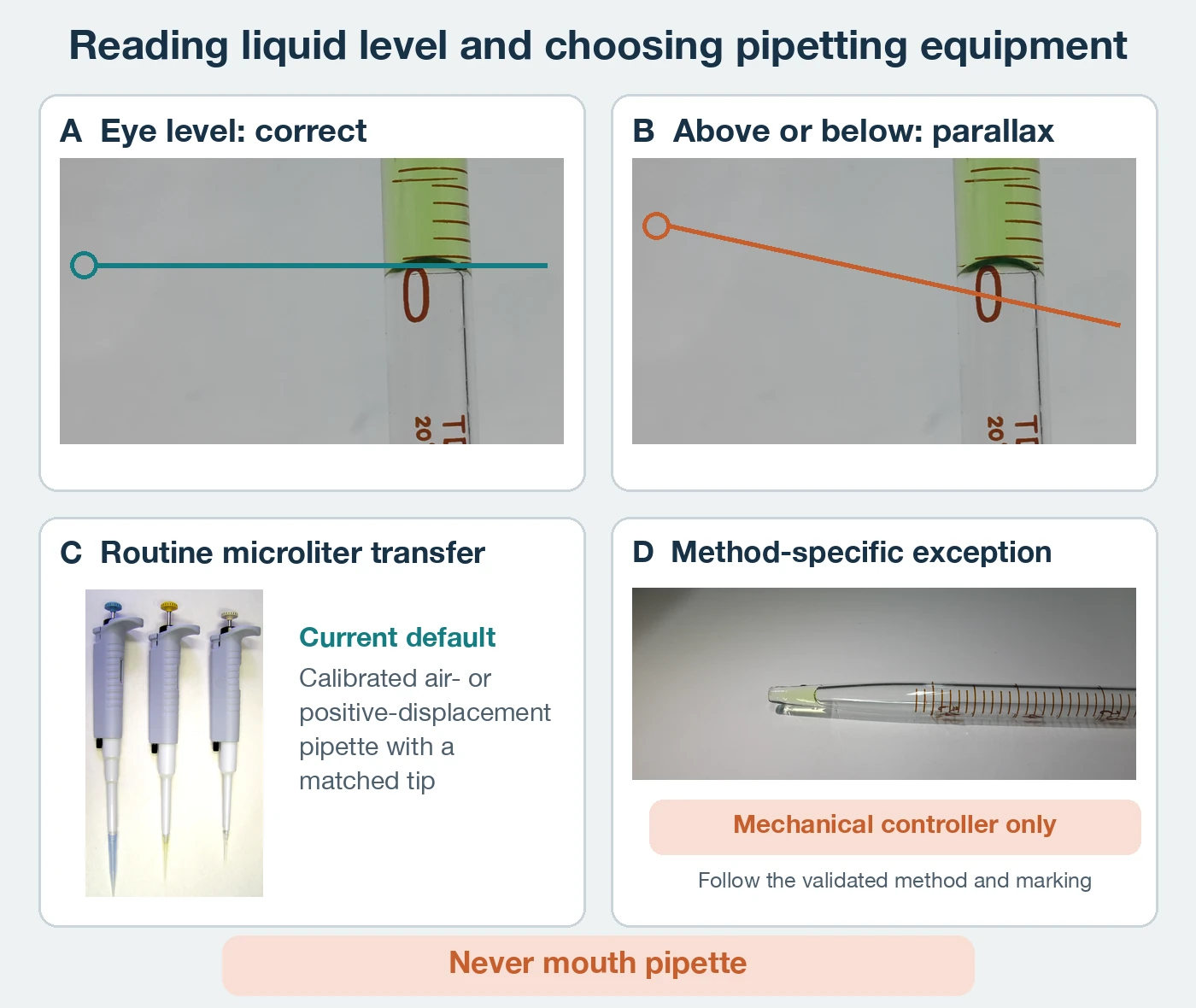
Class and marking state the manufactured tolerance. Fitness for a task also depends on cleanliness, damage, temperature, drainage time, and the uncertainty allowed by the measurement procedure. When a procedure requires documented performance, gravimetric re-verification of the glassware uses the weighing method described below for piston pipettes. An intact Class A flask is unsuitable for preparing a calibrator when its material interacts with the analyte.
Piston pipettes
An air-displacement pipette moves an air cushion between the piston and the liquid. Temperature differences, evaporation, viscosity, tip fit, immersion depth, aspiration angle, and plunger timing can change the delivered volume. A positive-displacement pipette moves a piston in direct contact with the liquid inside a capillary or tip, which improves delivery of viscous, volatile, foaming, or dense liquids. Dispensers and dilutors repeat-deliver measured volumes from a shared reservoir. Choose a device whose specified operating range covers the intended volume.
A sound pipetting sequence uses the specified tip, conditions the tip when the procedure calls for it, aspirates with the device near vertical at a consistent depth, pauses long enough for liquid entry, withdraws without droplets on the outside, and dispenses smoothly against the receiving vessel as instructed. Reverse pipetting, prewetting, or a positive-displacement device can address particular liquids. Each changes the procedure and requires local verification.
Gravimetric calibration determines delivered volume from the mass of delivered water, water density at the measured temperature, evaporation controls, and replicate deliveries. ISO 8655-6 states the gravimetric reference measurement procedure, and ISO 8655-7 describes alternative procedures for apparatus that gravimetry does not fit.6,7 ISO 8655-2 sets metrological requirements and maximum permissible errors for single-channel and multichannel air-displacement and positive-displacement pipettes, tested as complete systems with their selected tips.8 A photometric check, which uses a compound of known molar absorptivity such as potassium dichromate or compares a pipetted dilution with the same dilution prepared in Class A glassware, can screen pipette performance between gravimetric calibrations.1 The laboratory chooses acceptance criteria that satisfy the intended use and follows the pipette manufacturer's maintenance requirements.8 Routine performance checks detect leakage, seal wear, contamination, and technique problems. Set their frequency from risk, use, and performance history.
Mean delivered volume = mean mass × Z = 99.29 mg × 1.0033 µL/mg = 99.62 µL
Systematic error = mean delivered volume − selected volume = 99.62 µL − 100 µL = −0.38 µL
The systematic error is −0.38% of the selected volume. The standard deviation of the ten masses is 0.19 mg, which converts to a random error of 0.19 µL and a coefficient of variation of 0.19%. ISO 8655-2 sets the maximum permissible errors for a 100 µL single-channel pipette at its nominal volume at ±0.80 µL for systematic error and 0.30 µL for random error, so this pipette passes both limits.8 A result outside either limit takes the pipette out of service for adjustment or repair, followed by a repeat check, and the laboratory's procedure states which other volume settings the check must cover.
Containers, cleaning, and compatibility
Container material can adsorb an analyte, release additives, transmit gas or vapor, or fail in contact with a solvent. These effects depend on the exact polymer, the analyte, concentration, contact time, and temperature.
Scroll sideways to see all columns
| Material | Common laboratory role | Limitations to check |
|---|---|---|
| Polypropylene | Pipette tips, microtubes, centrifuge tubes | Broad chemical resistance and autoclavable; confirm the product's force and sterilization ratings |
| Polyethylene | Bottles, transfer devices, storage containers | Binds proteins and dyes; permeable to gases and vapors |
| Polystyrene | Clear rigid tubes, culture ware, optical vessels | Softens with heat, so it cannot be autoclaved; clouded by organic solvents; brittle |
| Polycarbonate | Strong transparent bottles and centrifuge ware | Attacked by strong alkali, acid, and oxidizing agents |
| Polytetrafluoroethylene | Liners, tubing, seals, chemically resistant vessels | Chemically near-inert; low surface energy reduces wetting and bonding |
Glass adsorbs metal ions, which makes ordinary glass a poor container for trace-metal work. Compatibility certifications such as certified-clean, low-binding, nuclease-free, sterile, and single-use are separate product properties, each verified against its own specification.
Begin cleaning before residue dries. Rinse immediately, use a laboratory detergent and a validated process, rinse repeatedly with water of the required grade, and compare the pH of the final rinse with the pH of the incoming rinse water. An alkaline drift indicates residual detergent.1 Inspect the item and prevent recontamination during drying and storage. Residual detergent can alter pH, suppress enzymes, change surface tension, and add optical background.
Balances, desiccators, and mass standards
Balances report mass, the quantity of matter. Weight is the gravitational force on that mass, and it varies with location. An analytical balance reads to 0.1 mg or finer behind a draft shield that keeps out air currents. Electronic balances null the displaced pan against an electromagnetic restoring force, and simpler bench designs read a strain gauge.
Readability is the smallest displayed increment, capacity the greatest permitted load, repeatability the agreement among repeated weighings of one load, and linearity the response across the range. Each characteristic is evaluated separately.
Before weighing, confirm that the balance is level, clean, stable, and protected from drafts, vibration, temperature gradients, and static charge. Center the load, close the draft shield, allow the reading to stabilize, and use tare only as the procedure intends. Under ASTM E617-23, laboratory weights and precision mass standards span classes 000 through 7, with class and nominal mass selected from the balance's readability and the required measurement uncertainty.9 Balance checks use standards at masses that challenge the working range, with documented traceability and uncertainty.2 Skin contact leaves moisture and salts on small mass standards, so handle weights with clean forceps or gloves.
A desiccator protects hygroscopic (moisture-absorbing) material and lets a heated vessel cool in a low-moisture enclosure before weighing. The desiccant's indicator, regeneration limit, and replacement schedule belong in the procedure. Anhydrous identifies a chemical form without water of crystallization. An opened anhydrous reagent stays anhydrous only when it is stored as the label requires.
Centrifugation
A centrifuge creates radial acceleration that separates components by density, size, shape, medium, and run conditions, and a spin can also free dissolved gas from a specimen. Revolutions per minute (rpm) describe rotor speed. Relative centrifugal force (RCF) accounts for both speed and rotor radius:
RCF = 1.118 × 10⁻⁵ × r × rpm2
Here, r is the radius in centimeters from the axis of rotation to the point in the tube where the separation is judged. Rotor manuals list the effective radius for each tube position, often as minimum, maximum, and average values, and the procedure states which one applies. For a 10 cm radius at 3,200 rpm:
RCF = 1.118 × 10−5 × 10 × 3,2002 = 1,145 × g (rounded)
The same rpm produces a different RCF in a different rotor, so program RCF whenever a method specifies RCF. A fixed-angle rotor sediments material along the tube wall toward the bottom. A swinging-bucket rotor lets tubes swing horizontal, which keeps layered interfaces level.
Before a run, inspect the rotor, buckets, seals, and rated tubes; verify that the load, speed, temperature, and time match the procedure; and balance opposing positions by mass as the manufacturer directs. Close the lid and let the rotor stop completely before opening it, because opening early aerosolizes the contents. Spin materials that generate aerosols under the containment practice in your laboratory's safety procedure. Verify speed periodically with a tachometer or a strobe light, and check timer, temperature, and braking performance on the schedule justified for the instrument and its applications.1
Reagents and laboratory water
Labels such as reagent grade, spectrophotometric grade, and chromatography grade name different specifications. American Chemical Society reagent grade is a common specification for general reagent work. Choose the grade named by the measurement procedure. A NIST Standard Reference Material carries certified property values with uncertainties, a stated intended use, and an expiration date, all documented on its certificate. Reference materials without certified values exist for uses such as control and stability assessment, and their documentation states this. Check the certificate and status against the use at hand.2
CLSI GP40, fifth edition, organizes medical-laboratory water by application: clinical laboratory reagent water, special reagent water including molecular biology water, instrument feed water, water supplied by a method manufacturer, autoclave and wash water, and commercially bottled purified water. The laboratory validates that the water it selects is fit for its purpose and trends the monitored parameters over time. Resistivity indicates ionic contamination, total organic carbon indicates organic contamination, and viable plate counts indicate microbial burden. Appropriate filtration or distillation controls particulate and colloidal contamination.10
Purification combines prefiltration, distillation or reverse osmosis, ion exchange, activated carbon, ultraviolet treatment, and membrane filtration in a sequence chosen against the incoming water and the final specification. Storage and distribution can recontaminate water after purification, so take monitoring samples at the point of use. Commercially bottled purified water is its own category and requires verification for the intended application.
Mixing and solution preparation
Mixing dissolves solids, resuspends settled cells and protein, and equalizes the concentration gradients that form in standing serum or thawed controls. Excessive mixing denatures protein and hemolyzes cells. A vortex mixes single tubes with adjustable speed, angle, and pressure. Tilting-disk rotors and rocking platforms handle tubes in batches, from gentle rocking of whole blood to vigorous reconstitution of controls. The specimen, the material's instructions, and the downstream measurement set the motion and duration. Stop and correct the technique if you see foaming, hemolysis, cell damage, or incomplete resuspension.
Solution preparation uses the equipment above in sequence:
- Confirm the chemical form, purity, formula mass, and safety precautions.
- Weigh with a balance suitable for the required uncertainty.
- Dissolve in less than the final solvent volume using compatible ware.
- Transfer quantitatively to a suitable volumetric flask.
- Equilibrate to the flask's calibration temperature when volume accuracy matters.
- Bring to the mark, mix completely, label, and store as the procedure requires.
For 300 mL of 0.200 mol/L anhydrous calcium chloride with a formula mass of 111.0 g/mol:
Required mass = concentration × volume × formula mass = 0.200 mol/L × 0.300 L × 111.0 g/mol = 6.66 g
Water of hydration or an assay value below 100% changes the mass calculation, so read the chemical form and assay on the label before you weigh. Molarity, normality, percent solutions, dilutions, and standard-curve calculations are covered in Laboratory Mathematics and Diagnostic Performance.1
Practice
References
- Bishop ML, Fody EP, Van Siclen C, Mistler JM, Moy M. Clinical Chemistry: Principles, Techniques, and Correlations. 9th ed. Jones & Bartlett Learning; 2023. Back to text
- Bruce SS, Possolo A, Watters RL Jr. Metrological Traceability: Frequently Asked Questions and NIST Policy. NIST Technical Note 2156. National Institute of Standards and Technology; 2021. Accessed August 31, 2026. Back to text
- National Institute of Standards and Technology. End of an era: NIST to cease calibrating mercury thermometers. Published February 2, 2011. Updated February 3, 2025. Accessed August 31, 2026. Back to text
- ASTM International. Standard Specification for Laboratory Glass Volumetric Apparatus. ASTM E694-18(2024). ASTM International; 2024. Back to text
- Occupational Safety and Health Administration. 29 CFR 1910.1030: Bloodborne pathogens. Section 1910.1030(d)(2)(xii). Accessed September 2, 2026. Back to text
- International Organization for Standardization. Piston-operated volumetric apparatus — Part 6: Gravimetric reference measurement procedure for the determination of volume. ISO 8655-6:2022. International Organization for Standardization; 2022. Accessed August 31, 2026. Back to text
- International Organization for Standardization. Piston-operated volumetric apparatus — Part 7: Alternative measurement procedures for the determination of volume. ISO 8655-7:2022. International Organization for Standardization; 2022. Accessed August 31, 2026. Back to text
- International Organization for Standardization. Piston-operated volumetric apparatus — Part 2: Pipettes. ISO 8655-2:2022. International Organization for Standardization; 2022. Accessed August 31, 2026. Back to text
- ASTM International. Standard Specification for Laboratory Weights and Precision Mass Standards. ASTM E617-23. ASTM International; 2023. Back to text
- Clinical and Laboratory Standards Institute. Preparation and Testing of Reagent Water in the Medical Laboratory. 5th ed. CLSI guideline GP40. Clinical and Laboratory Standards Institute; 2024. Accessed August 31, 2026. Back to text